
black-eyed Susan 'Giggling Smileyz'
Also known as: Information to be completed
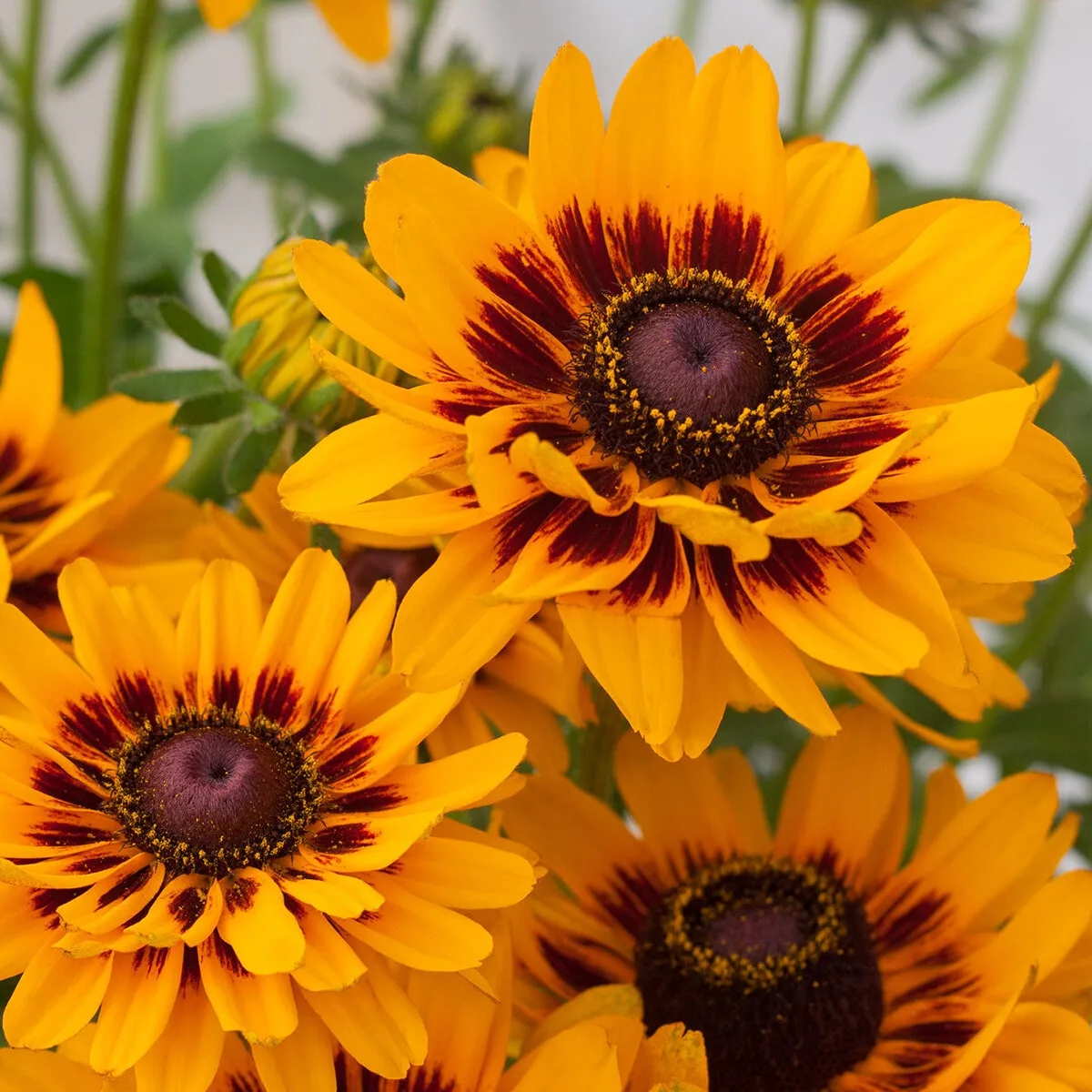
A compact, deciduous perennial often grown as an annual/biennial with green foliage and large, double butter-yellow daisy-like flowers with splashes of brown towards the centre of the petals, and a dark chocolate brown button-shaped centre, appearing from June to October
Scientific classification
- Species
- black-eyed Susan 'Giggling Smileyz' (Rudbeckia hirta 'Giggling Smileyz')
- Genus
- Rudbeckia
- Family
- Asteraceae
- Order
- Asterales
- Class
- Magnoliopsida
- Phylum
- Magnoliophyta
- Information to be completed
- Toxicity
- Annual Biennial
- Plant type
- 0.1-0.5 metres
- Height
- 0.1-0.5 metres
- Spread
- Deciduous
- Foliage
- Columnar upright
- Habit
- Summer · Autumn
- Season of interest
- Full sun · Partial shade
- Sunlight
- Information to be completed
- Ideal temperature









black-eyed Susan 'Giggling Smileyz' pictures
Distribution of black-eyed Susan 'Giggling Smileyz'
Distribution map
- Native
- Introduced
- Cultivated
Source:WCVP v16 · Royal Botanic Gardens, Kew · CC BY 3.0 · Boundaries:WGSRPD / TDWG
black-eyed Susan 'Giggling Smileyz' care guide
- Moderate regular watering, allowing brief slight drying between soakings
- Watering
- Full sun · Partial shade
- Sunlight

Watering
Moderate regular watering, allowing brief slight drying between soakings
Fertilizing
 Fertilizing
Balanced perennial feed every four weeks from spring through summer
Pruning
 Pruning
Deadhead spent flowers
Propagation
 Propagation
Propagate by seed sown with gentle heat in spring
Growing
 Growing
Best grown as a half-hardy annual. Grows well in moderately fertile, preferably heavy but well-drained soil in full sun or partial shade. See rudbeckia cultivation for further advice
Common pests and diseases
Diseases
May be susceptible to grey moulds if air circulation is poor
Pests
Generally pest-free
Explore the plant health library →




