
Oenothera lindheimeri 'White Dove'
Also known as: Information to be completed
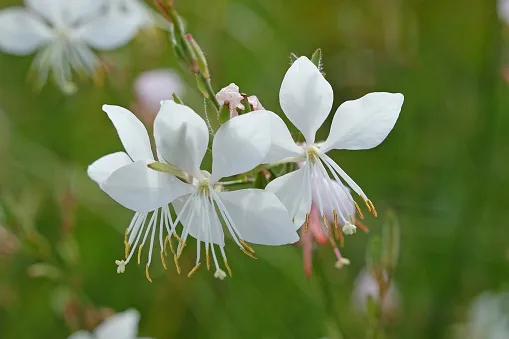
A bushy, compact, upright perennial with narrow sword-shaped leaves that have green-lime variegation. In summer and autumn it bears an abundance of white flowers emerging from pink-tinged buds. These are held on slender, wand-like stems, above the foliage.
Scientific classification
- Species
- Oenothera lindheimeri 'White Dove' (Oenothera lindheimeri 'White Dove')
- Genus
- Oenothera
- Family
- Onagraceae
- Order
- Myrtales
- Class
- Magnoliopsida
- Phylum
- Magnoliophyta
- Information to be completed
- Toxicity
- Herbaceous Perennial
- Plant type
- 0.5-1 metres
- Height
- 0.1-0.5 metres
- Spread
- Deciduous
- Foliage
- Clump forming · Bushy
- Habit
- Summer · Autumn · Winter
- Season of interest
- Full sun · Partial shade
- Sunlight
- Information to be completed
- Ideal temperature









Oenothera lindheimeri 'White Dove' pictures
Distribution of Oenothera lindheimeri 'White Dove'
Distribution map
- Native
- Introduced
- Cultivated
Source:WCVP v16 · Royal Botanic Gardens, Kew · CC BY 3.0 · Boundaries:WGSRPD / TDWG
Oenothera lindheimeri 'White Dove' care guide
- Regular mild watering, tolerate brief dryness after full plant establishment
- Watering
- Full sun · Partial shade
- Sunlight

Watering
Regular mild watering, tolerate brief dryness after full plant establishment
Fertilizing
 Fertilizing
Evening primrose dilute feed every three weeks warm blooming season
Pruning
 Pruning
If flowering diminishes, trim back by half during the growing season to encourage a fresh flush of flowers. Cut back hard in spring before growth begins.
Propagation
 Propagation
Propagate from seed sown in spring and early summer. Increase by division, softwood cuttings and basal softwood cuttings in spring, or semi-ripe heel cuttings in summer.
Growing
 Growing
Grow in fertile, moist but well-drained soil in full sun. Drought and partial shade are tolerated.
Common pests and diseases
Diseases
Generally disease-free
Pests
Generally pest-free
Explore the plant health library →




