
Oenothera lindheimeri 'Crimson Butterflies'
Also known as: Information to be completed
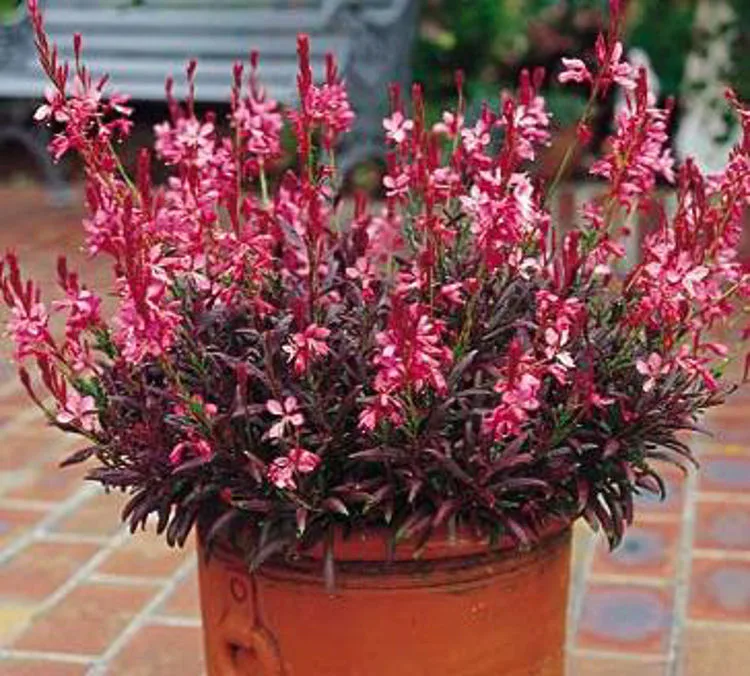
A compact, clump-forming perennial to around 50cm high, with narrow, lance-shaped leaves that are strongly flushed with reddish-bronze. Deep rose pink flowers open from dark red buds on slender, branching stems from early summer to early autumn
Scientific classification
- Species
- Oenothera lindheimeri 'Crimson Butterflies' (Oenothera lindheimeri 'Crimson Butterflies')
- Genus
- Oenothera
- Family
- Onagraceae
- Order
- Myrtales
- Class
- Magnoliopsida
- Phylum
- Magnoliophyta
- Information to be completed
- Toxicity
- Herbaceous Perennial
- Plant type
- 0.1-0.5 metres
- Height
- 0.1-0.5 metres
- Spread
- Deciduous
- Foliage
- Clump forming · Bushy
- Habit
- Spring · Summer · Autumn
- Season of interest
- Full sun · Partial shade
- Sunlight
- Information to be completed
- Ideal temperature









Oenothera lindheimeri 'Crimson Butterflies' pictures
Distribution of Oenothera lindheimeri 'Crimson Butterflies'
Distribution map
- Native
- Introduced
- Cultivated
Source:WCVP v16 · Royal Botanic Gardens, Kew · CC BY 3.0 · Boundaries:WGSRPD / TDWG
Oenothera lindheimeri 'Crimson Butterflies' care guide
- Moderate regular watering, allowing brief slight drying between soakings
- Watering
- Full sun · Partial shade
- Sunlight

Watering
Moderate regular watering, allowing brief slight drying between soakings
Fertilizing
 Fertilizing
Balanced perennial feed every four weeks from spring through summer
Pruning
 Pruning
Deadhead after flowering. Cut back plants in early spring
Propagation
 Propagation
Propagate by basal or softwood cuttings in spring, or semi-ripe cuttings in summer. As this plant is protected by Plant Breeders' Rights, any propagation should be for personal rather than commercial use
Growing
 Growing
Thrives in fertile, moist but well-drained soil in full sun, though will tolerate light or part-day shade. Some drought tolerance once established, protect from excess winter wet. Plants can be short-lived, and dislike transplanting
Common pests and diseases
Diseases
Generally disease-free
Pests
Generally pest-free
Explore the plant health library →




