
hebe 'Wild Romance'
Also known as: Information to be completed
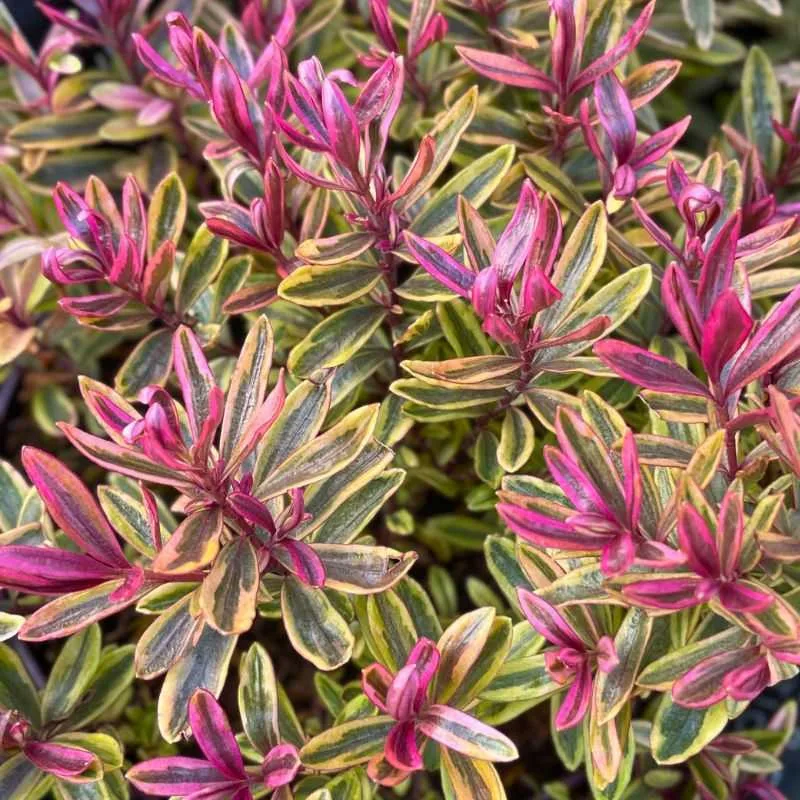
A compact shrub to 60cm tall, with narrow, green spear-shaped leaves, with cream margins. In spring, the new growth at the tips of the stems is bright pink, contrasting with the green and cream leaves lower down the stem and in autumn the foliage turns deep pink maroon. Spikes of purple flowers are produced in summer
Scientific classification
- Species
- hebe 'Wild Romance' (Veronica 'Wild Romance')
- Genus
- Veronica
- Family
- Plantaginaceae
- Information to be completed
- Toxicity
- Shrubs
- Plant type
- 0.5-1 metres
- Height
- 0.5-1 metres
- Spread
- Evergreen
- Foliage
- Bushy
- Habit
- Autumn · Winter · Spring · Summer
- Season of interest
- Full sun
- Sunlight
- Information to be completed
- Ideal temperature









hebe 'Wild Romance' pictures
Distribution of hebe 'Wild Romance'
Distribution map
Information to be completed
Information to be completed
Culture
Information to be completed
Toxicity
Information to be completed
Quick identification of hebe 'Wild Romance'
Information to be completed
hebe 'Wild Romance' care guide
- Water thoroughly when topsoil layer dries out completely
- Watering
- Full sun
- Sunlight
- Information to be completed
- Ideal temperature

Watering
Water thoroughly when topsoil layer dries out completely
Fertilizing
 Fertilizing
Light balanced flowering feed monthly spring through autumn
Pruning
 Pruning
Prune lightly as needed to remove unwanted shoots and keep the shrub in shape. Prune in mid- to late spring.
Propagation
 Propagation
Propagate from semi-hardwood cutting in late summer or early autumn for your own use
Growing
 Growing
Easy to grow in well-drained soil in full sun
People also ask
Information to be completed
Common pests and diseases
Diseases
May be susceptible to downy mildews, fungal leaf spot, fungal rot, Phytophthora and sometimes honey fungus
Pests
May be susceptible to aphids
Explore the plant health library →




