
Bulbophyllum picturatum
Also known as: Information to be completed
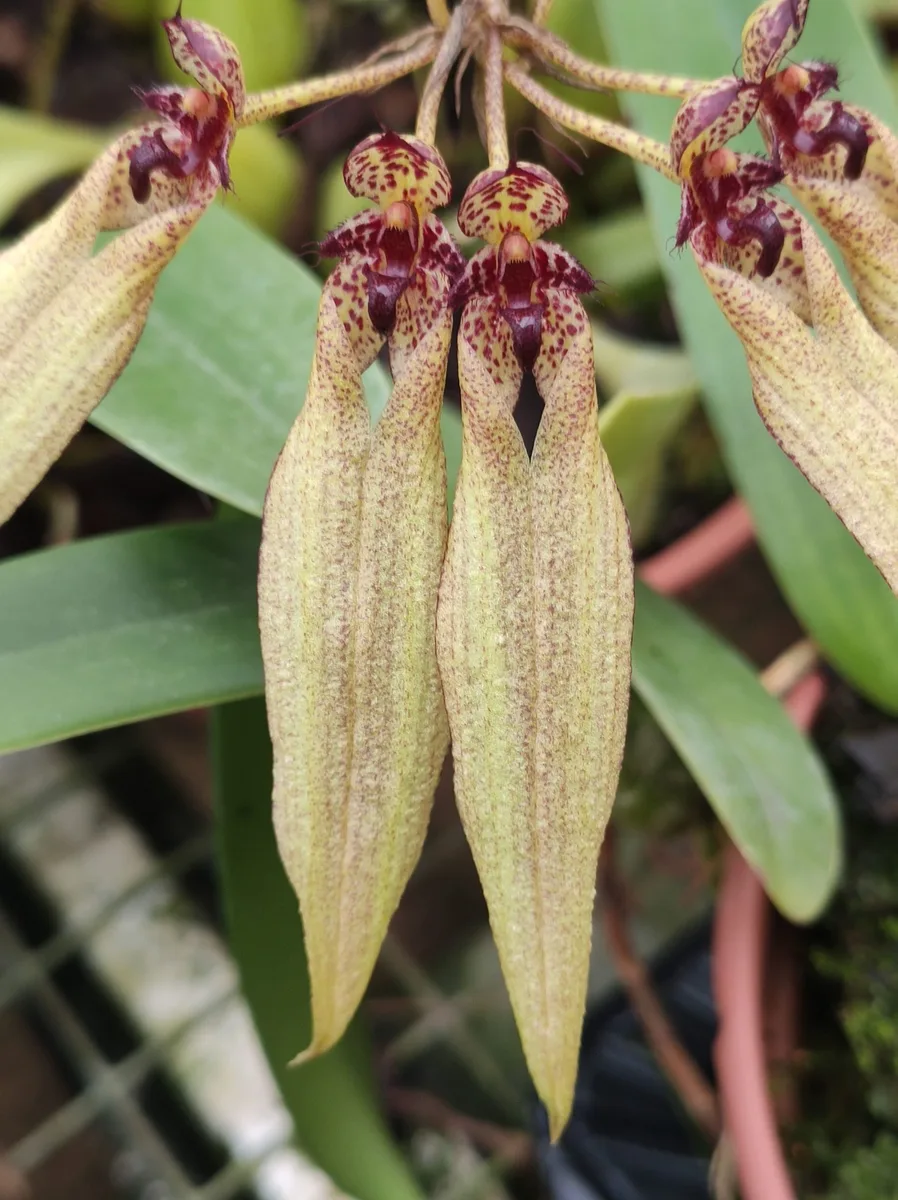
Small-sized, warm to cool growing epiphytic orchid species with typical, spreading, rhizomatous growth. Each pseudobulb - which is a morphological adaptation of stem for storing water and nutrients, carries one cm long green, leathery leaf. Flowering stems appear from the base of older pseudobulbs and carry 5-10 unusual-looking flowers, arranged it tight umbels. Each flower is approximately 5cm long, with two side sepals fused downwards, along most of the length. Dorsal sepal is short, creating a ''cap'' above the centre of flower with intricate tiny petals, yellow column and dark red lip.
Scientific classification
- Species
- Bulbophyllum picturatum (Bulbophyllum picturatum)
- Genus
- Bulbophyllum
- Family
- Orchidaceae
- Order
- Asparagales
- Class
- Liliopsida
- Phylum
- Magnoliophyta
- Information to be completed
- Toxicity
- Information to be completed
- Plant type
- Up to 10 cm
- Height
- 0.1-0.5 metres
- Spread
- Evergreen
- Foliage
- Information to be completed
- Habit
- Spring · Summer · Autumn · Winter
- Season of interest
- Partial shade
- Sunlight
- Information to be completed
- Ideal temperature









Bulbophyllum picturatum pictures
Distribution of Bulbophyllum picturatum
Distribution map
- Native
- Introduced
- Cultivated
Source:WCVP v16 · Royal Botanic Gardens, Kew · CC BY 3.0 · Boundaries:WGSRPD / TDWG
Bulbophyllum picturatum care guide
- Moderate regular watering, allowing slight drying between waterings
- Watering
- Partial shade
- Sunlight

Watering
Moderate regular watering, allowing slight drying between waterings
Fertilizing
 Fertilizing
Balanced feed monthly during active growth season
Pruning
 Pruning
No pruning required. Remove spent flower stem at the base.
Propagation
 Propagation
 by seed is only possible in a controlled laboratory environment. Mature plants may be divided when the plant overgrows its container. Each division should have at least 3 older pseudobulbs with a suffient amount of stored energy and water, to support new growth and reduce stress after repotting.
Growing
 Growing
Grow in an open, free-draining, bark-based orchid compost with addition of perlite and sphagnum moss. Due to plants' spreading growth habit, they are best acommodated in wide, shallow pots or baskets. Provide enough filtered light, but keep away from direct sunlight or a heating source. Plants require high humidity and frequent watering. Ensure that all water drains away, preventing the plant sitting wet. Orchid fertiliser can be applied regularly throughout the growing season. Reduce watering and feeding in winter months. Ideal temperatures are around minimum 14°C at night and up to maximum 30 °C during day. For best flowering, amplitudes of temperatures between daytime and night should be at least 8 -10 °C, even more in summer months.
Common pests and diseases
Diseases
Generally disease-free.
Pests
May be susceptible to mealybugs and scale insects infestations.
Explore the plant health library →




