
grey-white blueberry
Also known as: Information to be completed
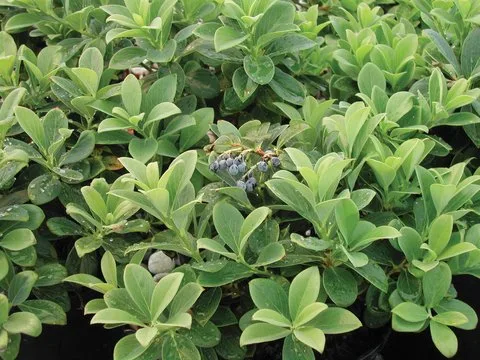
a spreading evergreen shrub with oval, dark grey-green leaves white beneath, and pale pink, cylindrical flowers in silvery-bracted racemes to 8cm in length, followed by white-bloomed black berries
Scientific classification
- Species
- grey-white blueberry (Vaccinium glaucoalbum)
- Genus
- Vaccinium
- Family
- Ericaceae
- Order
- Ericales
- Class
- Magnoliopsida
- Phylum
- Magnoliophyta
- Information to be completed
- Toxicity
- Shrubs
- Plant type
- 1-1.5 metres
- Height
- 0.5-1 metres
- Spread
- Evergreen
- Foliage
- Bushy
- Habit
- Spring · Summer · Autumn · Winter
- Season of interest
- Full shade · Full sun · Partial shade
- Sunlight
- Information to be completed
- Ideal temperature









grey-white blueberry pictures
Distribution of grey-white blueberry
Distribution map
- Native
- Introduced
- Cultivated
Source:WCVP v16 · Royal Botanic Gardens, Kew · CC BY 3.0 · Boundaries:WGSRPD / TDWG
grey-white blueberry care guide
- Consistently moist acidic soil, supply regular soft rainwater ideally
- Watering
- Full shade · Full sun · Partial shade
- Sunlight

Watering
Consistently moist acidic soil, supply regular soft rainwater ideally
Fertilizing
 Fertilizing
Acid-loving plant fertilizer applied monthly throughout spring and summer
Pruning
 Pruning
Usually little pruning is needed. Lightly shape if necessary, removing dead, damaged or diseased shoots. Prune after flowering.
Propagation
 Propagation
Propagate by semi-hardwood cuttings in mid to late summer or layer in mid-summer. Propagate by seed sown, in containers, in a cold-frame in autumn
Growing
 Growing
Grows well in extremely acid soils that are moist but well-drained. Tolerant of shade and woodland edges. Susceptible to frost damage and delayed flowering in colder climes
Common pests and diseases
Diseases
May be susceptible to honey fungus (rarely), powdery mildews, root rot and chlorosis due to iron and manganese deficiency; see nutrient deficiencies
Pests
Generally pest-free
Explore the plant health library →




