
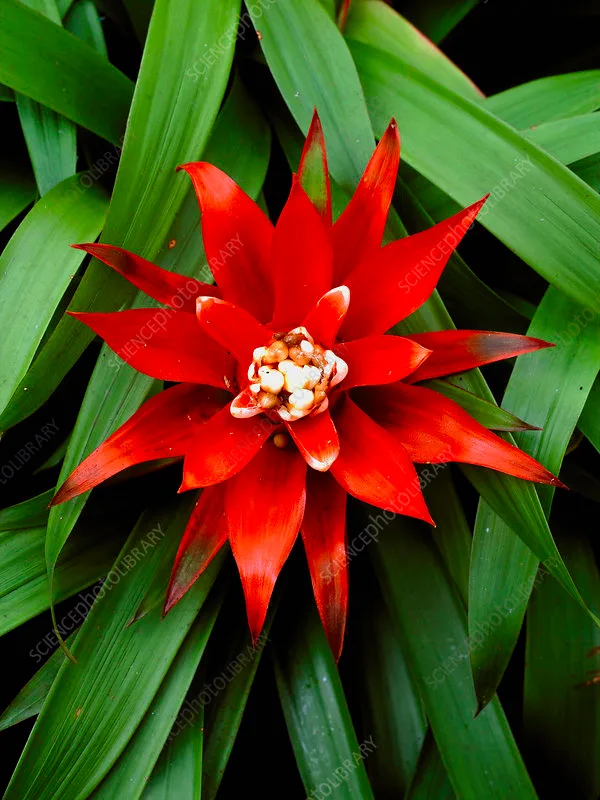
lesser scarlet star
Also known as: Information to be completed
An evergreen, epiphytic bromeliad to 30cm high, with funnel-shaped rosettes of long, smooth, strappy green leaves, held by dark green sheaths beneath. Produces upright flower stems of small creamy white flowers surrounded by large, bright red bracts in summer
Scientific classification
- Species
- lesser scarlet star (Guzmania lingulata var. minor)
- Genus
- Guzmania
- Family
- Bromeliaceae
- Order
- Poales
- Class
- Liliopsida
- Phylum
- Tracheophyta
- Information to be completed
- Toxicity
- Conservatory Greenhouse · Houseplants
- Plant type
- 0.1-0.5 metres
- Height
- 0.1-0.5 metres
- Spread
- Evergreen
- Foliage
- Clump forming
- Habit
- Spring · Summer · Autumn · Winter
- Season of interest
- Full sun
- Sunlight
- Information to be completed
- Ideal temperature









lesser scarlet star pictures
Distribution of lesser scarlet star
Distribution map
- Native
- Introduced
- Cultivated
Source:WCVP v16 · Royal Botanic Gardens, Kew · CC BY 3.0 · Boundaries:WGSRPD / TDWG
lesser scarlet star care guide
- Fill central cup with water, lightly moisten surrounding potting soil
- Watering
- Full sun
- Sunlight

Watering
Fill central cup with water, lightly moisten surrounding potting soil
Fertilizing
 Fertilizing
Weak bromeliad fertilizer monthly during spring and summer growth
Pruning
 Pruning
No pruning required
Propagation
 Propagation
Propagate by seed sown at 27°C (81°F), or by division. Seedlings may take years to flower. Guzmania are monocarpic and will die down after flowering, but usually go on to produce offsets that can be removed and grown separately
Growing
 Growing
Grow in a loam-free, free draining potting mix, such as a mix of fine bark, perlite and coir fibre, or grow epiphytically on artificial tree branches. Position in bright, filtered light and mist daily with rainwater when in growth. See bromeliad cultivation for more detailed advice
Common pests and diseases
Diseases
Generally disease-free
Pests
May be susceptible to mealybugs
Explore the plant health library →




