
pink English lavender
Also known as: Information to be completed
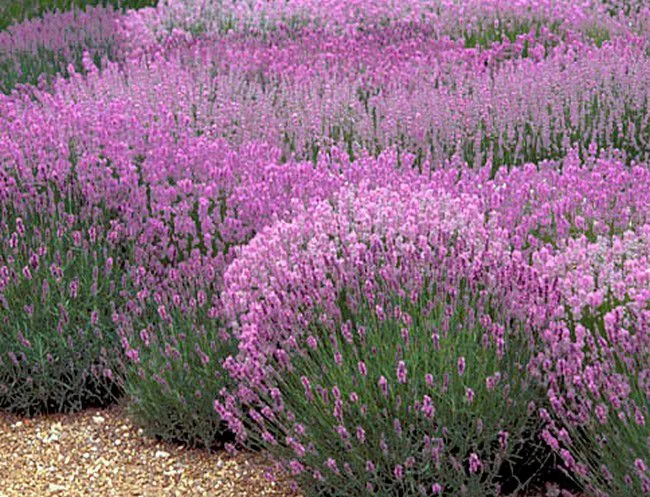
A bushy, compact evergreen shrub with narrow linear silver-grey leaves bearing prolific spikes of fragrant, pale pink flowers in summer.
Scientific classification
- Species
- pink English lavender (Lavandula angustifolia 'Rosea')
- Genus
- Lavandula
- Family
- Lamiaceae
- Order
- Lamiales
- Class
- Magnoliopsida
- Phylum
- Magnoliophyta
- Information to be completed
- Toxicity
- Shrubs
- Plant type
- 0.1-0.5 metres
- Height
- 0.1-0.5 metres
- Spread
- Evergreen
- Foliage
- Bushy
- Habit
- Spring · Summer · Autumn · Winter
- Season of interest
- Full sun
- Sunlight
- Information to be completed
- Ideal temperature









pink English lavender pictures
pink English lavender care guide
- Moderate regular watering, allowing brief slight drying between soakings
- Watering
- Full sun
- Sunlight

Watering
Moderate regular watering, allowing brief slight drying between soakings
Fertilizing
 Fertilizing
Balanced perennial feed every four weeks from spring through summer
Pruning
 Pruning
Shorten flowered shoots to about 1.5–2.5 cm from the previous year's growth. If flowering is on last year's growth, prune after flowering; if on current-year growth, prune the following early to mid-spring.
Propagation
 Propagation
Propagate by softwood or semi-ripe cuttings.
Growing
 Growing
Prefers free-draining , poor to moderately fertile, neutral to alkaline soil. Avoid planting in heavy clay or waterlogged soils. A sunny position is needed for maximum flowering. Can become woody and untidy without annual pruning. See lavender cultivation for further advice
Common pests and diseases
Diseases
May be susceptible to grey moulds (Botrytis) and honey fungus (rarely)
Pests
May be susceptible to rosemary beetle, cuckoo spit and sage leafhopper
Explore the plant health library →




