
trumpet vine 'Flamenco'
Also known as: Information to be completed
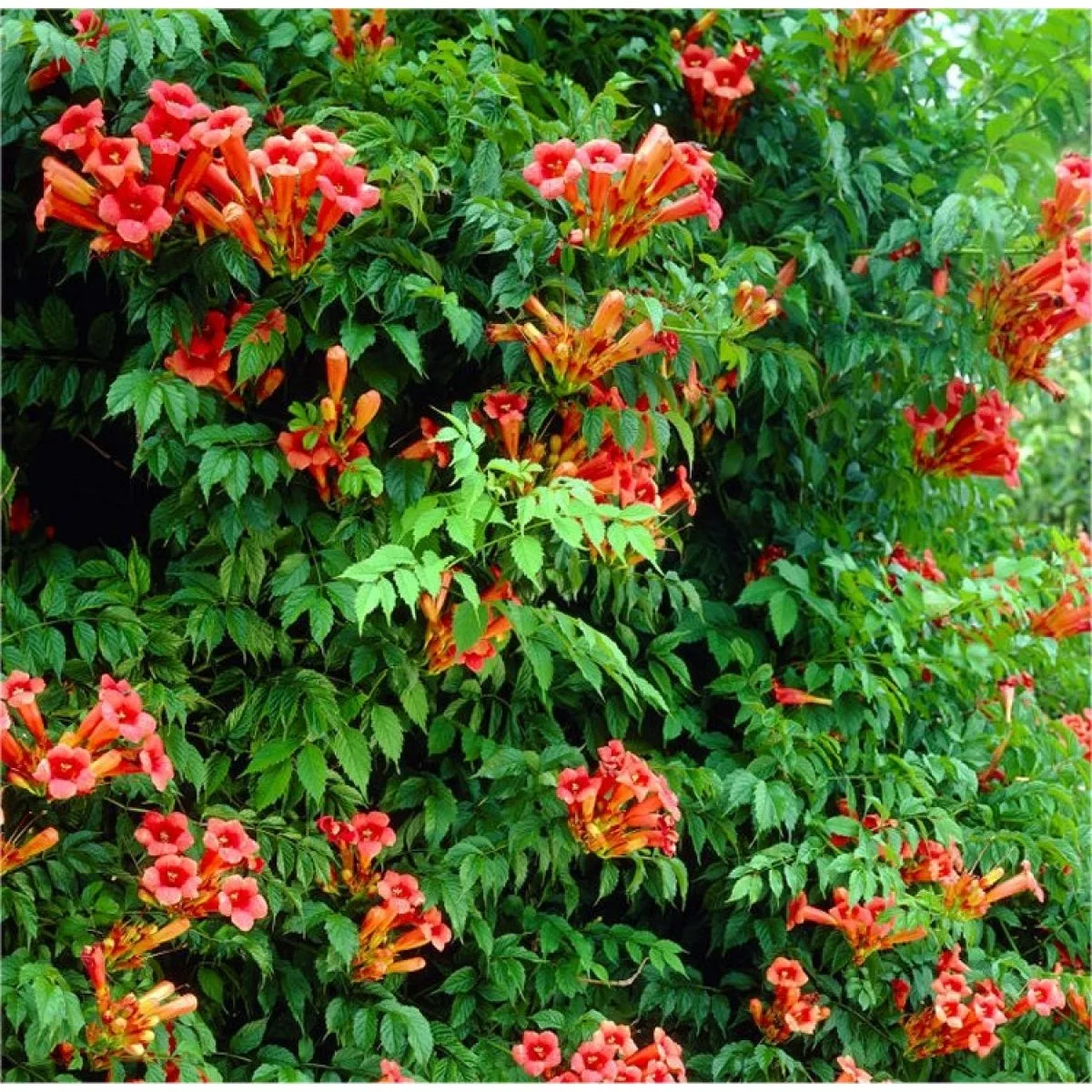
A vigorous, deciduous, woody-stemmed, root climber to heights exceeding 10m. Leaves are divided into 9 or 11, coarsely-toothed, oval leaflets that are downy on their undersides. Flowers borne in small clusters from summer into autumn are trumpet-shaped, up to 8cm long and orange-red with orange throats
Scientific classification
- Species
- trumpet vine 'Flamenco' (Campsis radicans 'Flamenco')
- Genus
- Campsis
- Family
- Bignoniaceae
- Order
- Lamiales
- Class
- Magnoliopsida
- Phylum
- Magnoliophyta
- Information to be completed
- Toxicity
- Climber Wall Shrub
- Plant type
- 8-12 metres
- Height
- 2.5-4 metres
- Spread
- Deciduous
- Foliage
- Climbing
- Habit
- Spring · Summer · Autumn
- Season of interest
- Full sun
- Sunlight
- Information to be completed
- Ideal temperature









trumpet vine 'Flamenco' pictures
Distribution of trumpet vine 'Flamenco'
Distribution map
- Native
- Introduced
- Cultivated
Source:WCVP v16 · Royal Botanic Gardens, Kew · CC BY 3.0 · Boundaries:WGSRPD / TDWG
trumpet vine 'Flamenco' care guide
- Moderate regular watering, avoid prolonged drought or waterlogging
- Watering
- Full sun
- Sunlight

Watering
Moderate regular watering, avoid prolonged drought or waterlogging
Fertilizing
 Fertilizing
Balanced feed in spring and light repeat in growth season
Pruning
 Pruning
On established plants, shorten sideshoots to three or four buds from the permanent framework; remove crowded or damaged shoots. Prune annually after flowering on last-year growth, or in late winter or early spring on current-year growth.
Propagation
 Propagation
Propagate by seed, layering, hardwood cuttings or root cuttings
Growing
 Growing
A climber that despite its exotic-looking flowers is reasonably hardy if grown against a warm, sunny wall in moderately fertile, moist but well-drained soil
Common pests and diseases
Diseases
May be susceptible to honey fungus
Pests
May be susceptible to aphids
Explore the plant health library →




