
Campanula carpatica f. alba
Also known as: Information to be completed
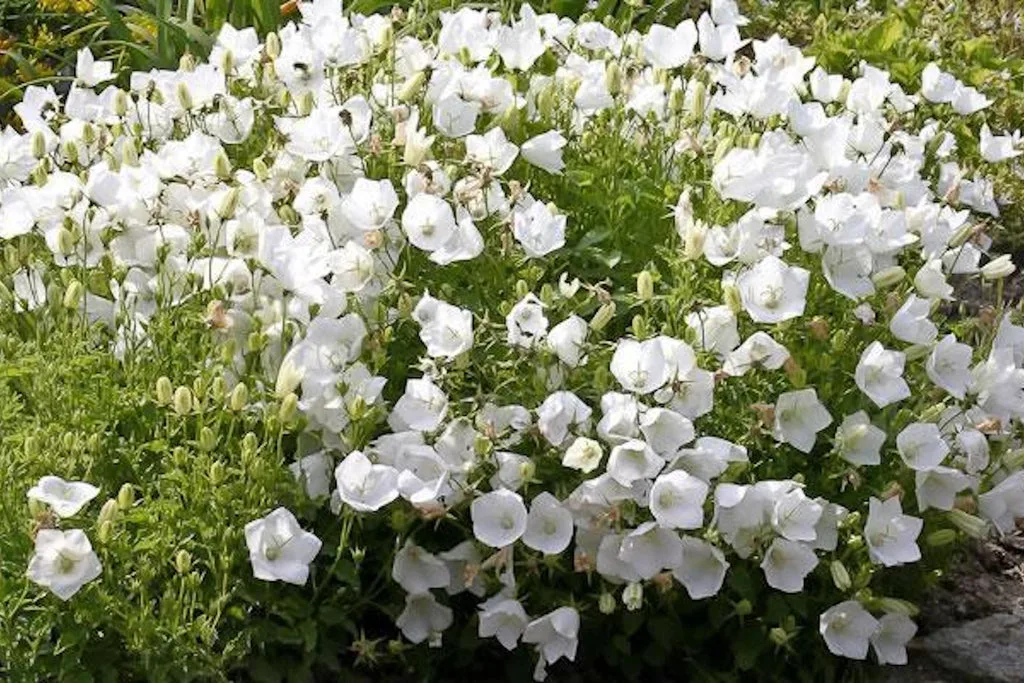
A low growing perennial that forms neat, compact mounds of small, green, toothed lance-shaped foliage. Numerous, outward facing, pure white, bell-shaped single flowers are borne on short stalks sitting just above its foliage providing a long flowering display in summer. An easy to grow plant that dislikes wet winters.
Scientific classification
- Species
- Campanula carpatica f. alba (Campanula carpatica f. alba)
- Genus
- Campanula
- Family
- Campanulaceae
- Information to be completed
- Toxicity
- Herbaceous Perennial
- Plant type
- 0.1-0.5 metres
- Height
- 0.1-0.5 metres
- Spread
- Deciduous
- Foliage
- Clump forming
- Habit
- Spring · Summer · Autumn
- Season of interest
- Full sun · Partial shade
- Sunlight
- Information to be completed
- Ideal temperature









Campanula carpatica f. alba pictures
Distribution of Campanula carpatica f. alba
Distribution map
Carpathians
Information to be completed
Culture
Information to be completed
Toxicity
Information to be completed
Quick identification of Campanula carpatica f. alba
Information to be completed
Campanula carpatica f. alba care guide
- Moderate regular watering, allowing brief slight drying between soakings
- Watering
- Full sun · Partial shade
- Sunlight
- Information to be completed
- Ideal temperature

Watering
Moderate regular watering, allowing brief slight drying between soakings
Fertilizing
 Fertilizing
Balanced perennial feed every four weeks from spring through summer
Pruning
 Pruning
No pruning required
Propagation
 Propagation
Propagate by seed or basal cuttings
Growing
 Growing
Will grow well in well-drained soil preferably in full sun to partial shade. Avoid wet winter conditions, adding a mineral mulch to the soil surface can be beneficial.
People also ask
Information to be completed
Common pests and diseases
Diseases
May be susceptible to a rust, powdery mildews and leaf spot
Pests
May be susceptible to slugs and snails
Explore the plant health library →




