
dusty daisy bush 'Comber's Blue'
Also known as: Information to be completed
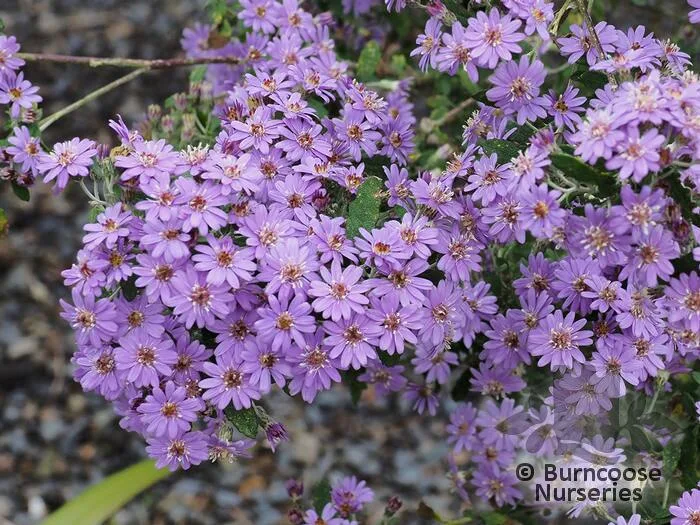
Comber's Blue' is an upright shrub up to 2m high with oblong to narrowly obovate, aromatic leaves 3-4cm long with shallowly toothed wavy edges, grey-green above, densely covered with white or grey-white wool below, and many clusters up to 7cm across of flowerheads, each 3cm across and with mid-blue ray-florets and yellow centres, so that they look like shrubby Michaelmas daisies, but flowering in spring and early summer
Scientific classification
- Species
- dusty daisy bush 'Comber's Blue' (Olearia phlogopappa 'Comber's Blue')
- Genus
- Olearia
- Family
- Asteraceae
- Order
- Asterales
- Class
- Magnoliopsida
- Phylum
- Magnoliophyta
- Information to be completed
- Toxicity
- Shrubs
- Plant type
- 1.5-2.5 metres
- Height
- 1.5-2.5 metres
- Spread
- Evergreen
- Foliage
- Columnar upright
- Habit
- Spring · Summer · Autumn · Winter
- Season of interest
- Full sun
- Sunlight
- Information to be completed
- Ideal temperature









dusty daisy bush 'Comber's Blue' pictures
Distribution of dusty daisy bush 'Comber's Blue'
Distribution map
- Native
- Introduced
- Cultivated
Source:WCVP v16 · Royal Botanic Gardens, Kew · CC BY 3.0 · Boundaries:WGSRPD / TDWG
dusty daisy bush 'Comber's Blue' care guide
- Moderate deep watering during dry periods, free drainage preferred
- Watering
- Full sun
- Sunlight

Watering
Moderate deep watering during dry periods, free drainage preferred
Fertilizing
 Fertilizing
Balanced shrub feed once in spring
Pruning
 Pruning
Usually little pruning is needed. Lightly shape if necessary, removing dead, damaged or diseased shoots. Prune after flowering.
Propagation
 Propagation
Propagate by semi-ripe cuttings in summer, by heeled hardwood cuttings of lateral shoots in a cold frame in early autumn, or by softwood cuttings treated with rooting hormone and rooted in a closed case or under mist in spring
Growing
 Growing
Grow in a sheltered position in well-drained soil in full sun
Common pests and diseases
Diseases
Generally disease-free but may be susceptible to honey fungus (rarely)
Pests
Generally pest-free
Explore the plant health library →




