
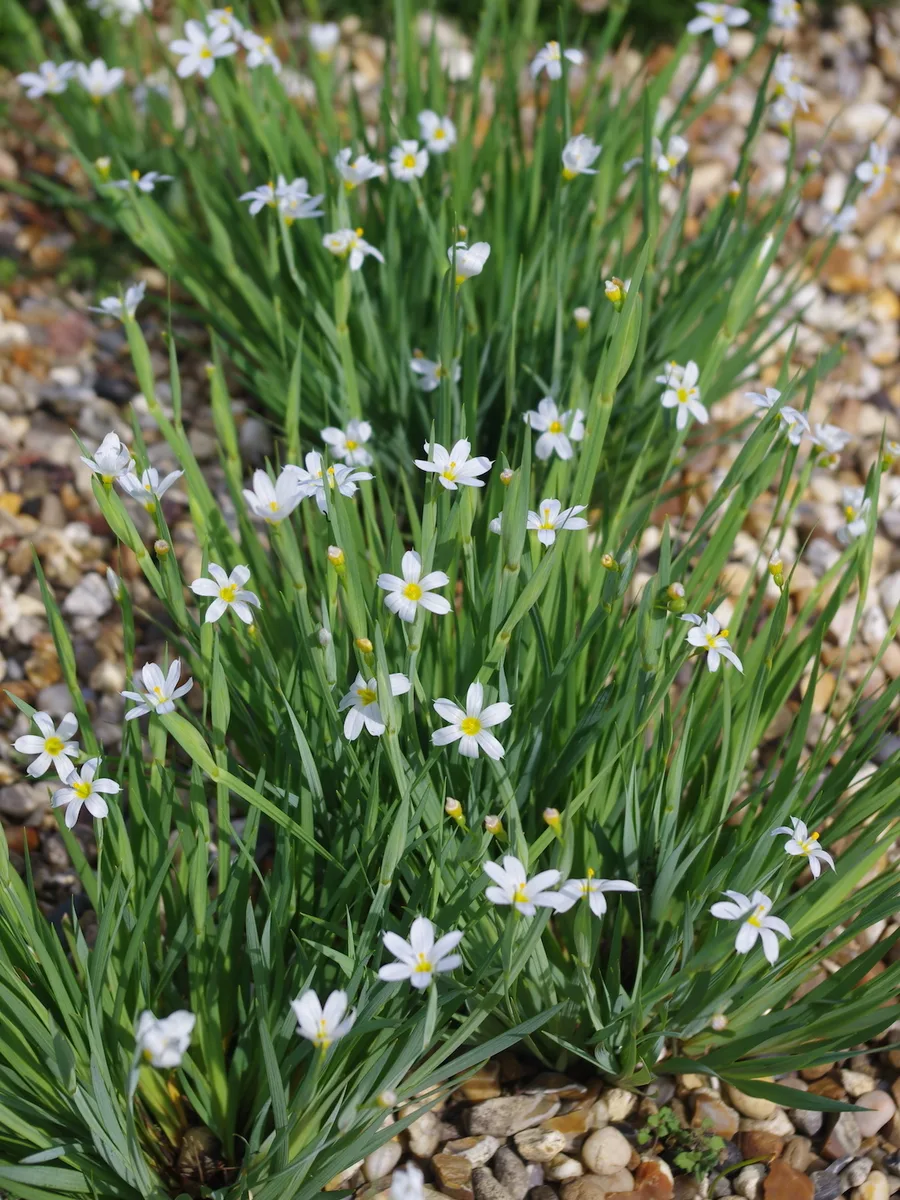
white-flowered narrow-leaved blue-eyed grass
Also known as: Information to be completed
A compact perennial to 25cm high forming small clumps of narrow, grass-like, dark green foliage and bearing clusters of small, star-like, white flowers with yellow eyes from late spring intil late summer
Scientific classification
- Species
- white-flowered narrow-leaved blue-eyed grass (Sisyrinchium angustifolium f. album)
- Genus
- Sisyrinchium
- Family
- Iridaceae
- Order
- Asparagales
- Class
- Liliopsida
- Phylum
- Magnoliophyta
- Information to be completed
- Toxicity
- Herbaceous Perennial
- Plant type
- 0.1-0.5 metres
- Height
- 0.1-0.5 metres
- Spread
- Semi evergreen
- Foliage
- Tufted · Clump forming
- Habit
- Spring · Summer · Autumn · Winter
- Season of interest
- Full sun
- Sunlight
- Information to be completed
- Ideal temperature









white-flowered narrow-leaved blue-eyed grass pictures
Distribution of white-flowered narrow-leaved blue-eyed grass
Distribution map
- Native
- Introduced
- Cultivated
Source:WCVP v16 · Royal Botanic Gardens, Kew · CC BY 3.0 · Boundaries:WGSRPD / TDWG
white-flowered narrow-leaved blue-eyed grass care guide
- Moderate steady soil moisture, extra water in prolonged hot dry weather
- Watering
- Full sun
- Sunlight

Watering
Moderate steady soil moisture, extra water in prolonged hot dry weather
Fertilizing
 Fertilizing
Diluted grassy perennial feed every four weeks spring through autumn
Pruning
 Pruning
No pruning required
Propagation
 Propagation
Propagate by seed or by division
Growing
 Growing
Grow in a poor to moderately fertile, well-drained, neutral to slightly alkaline soil in full sun. Protect from excessive winter wet. May have the potential to become a nuisance as seeds prolifically
Common pests and diseases
Diseases
May be susceptible to root rot
Pests
Generally pest-free
Explore the plant health library →




