
herb robert 'Album'
Also known as: Information to be completed
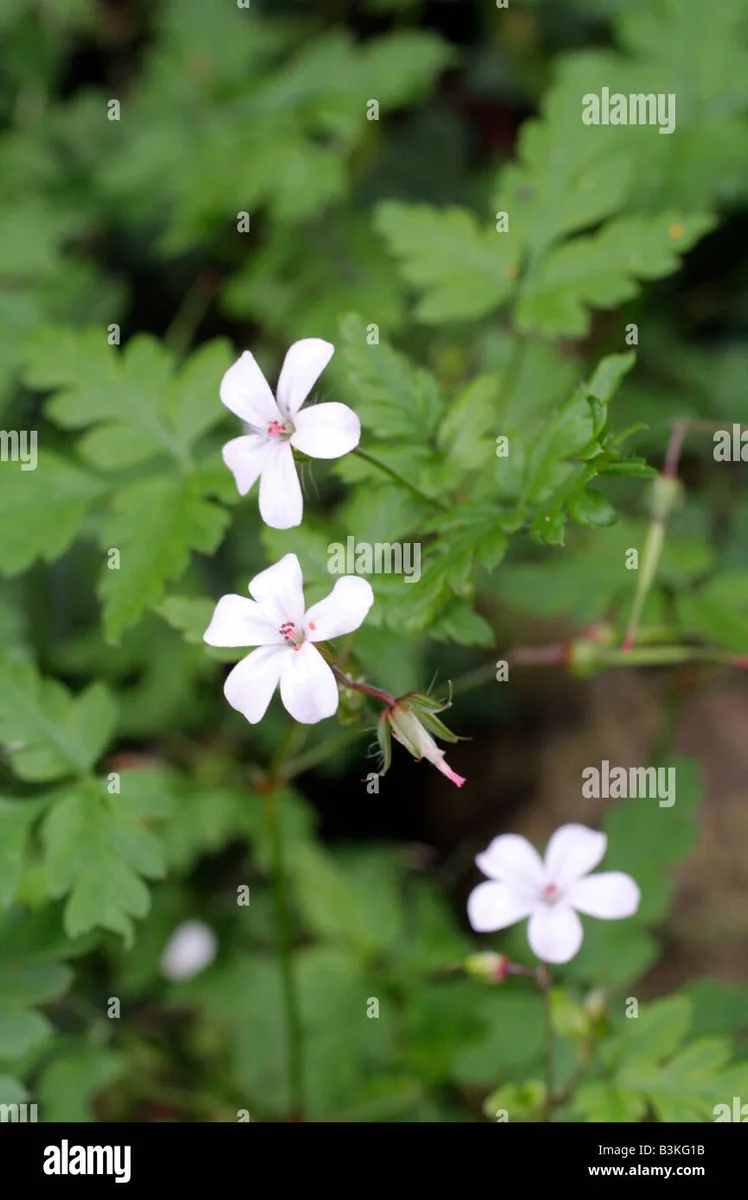
A trailing, hairy, strongly aromatic annual or biennial up to 50cm high, with leaves which are deeply divided into three lobes, the lobes in turn deeply divided, and which are mid-green tinged with red-brown, turning red in autumn, and star-shaped white or very pale pink flowers with brown sepals; it often flowers in its first summer and autumn, and overwinters to flower again from early spring; many people dislike the smell of the leaves
Scientific classification
- Species
- herb robert 'Album' (Geranium robertianum 'Album')
- Genus
- Geranium
- Family
- Geraniaceae
- Order
- Geraniales
- Class
- Magnoliopsida
- Phylum
- Tracheophyta
- Information to be completed
- Toxicity
- Annual Biennial
- Plant type
- 0.1-0.5 metres
- Height
- 0.1-0.5 metres
- Spread
- Deciduous
- Foliage
- Trailing
- Habit
- Autumn · Spring · Summer
- Season of interest
- Full shade · Full sun · Partial shade
- Sunlight
- Information to be completed
- Ideal temperature









herb robert 'Album' pictures
Distribution of herb robert 'Album'
Distribution map
- Native
- Introduced
- Cultivated
Source:WCVP v16 · Royal Botanic Gardens, Kew · CC BY 3.0 · Boundaries:WGSRPD / TDWG
herb robert 'Album' care guide
- Moderate watering, allow slight drying between soakings
- Watering
- Full shade · Full sun · Partial shade
- Sunlight

Watering
Moderate watering, allow slight drying between soakings
Fertilizing
 Fertilizing
Light balanced feed in spring and midsummer
Pruning
 Pruning
No pruning required
Propagation
 Propagation
Propagate by seed (sown outdoors) as soon as seed is ripe or in spring; it self-sows freely, and cultivars come true from seed, being mostly self-pollinating
Growing
 Growing
Grow in sun or shade in well-drained soil
Common pests and diseases
Diseases
Generally disease-free, but may be affected by a rust, a downy mildew, leafy gall, and virus diseases; may also be affected by powdery mildews in dry conditions
Pests
Generally pest-free, but may be affected by capsid bug, geranium sawfly, vine weevil, slugs and snails
Explore the plant health library →




