
Chilean fire bush 'Inca Flame'
Also known as: Information to be completed
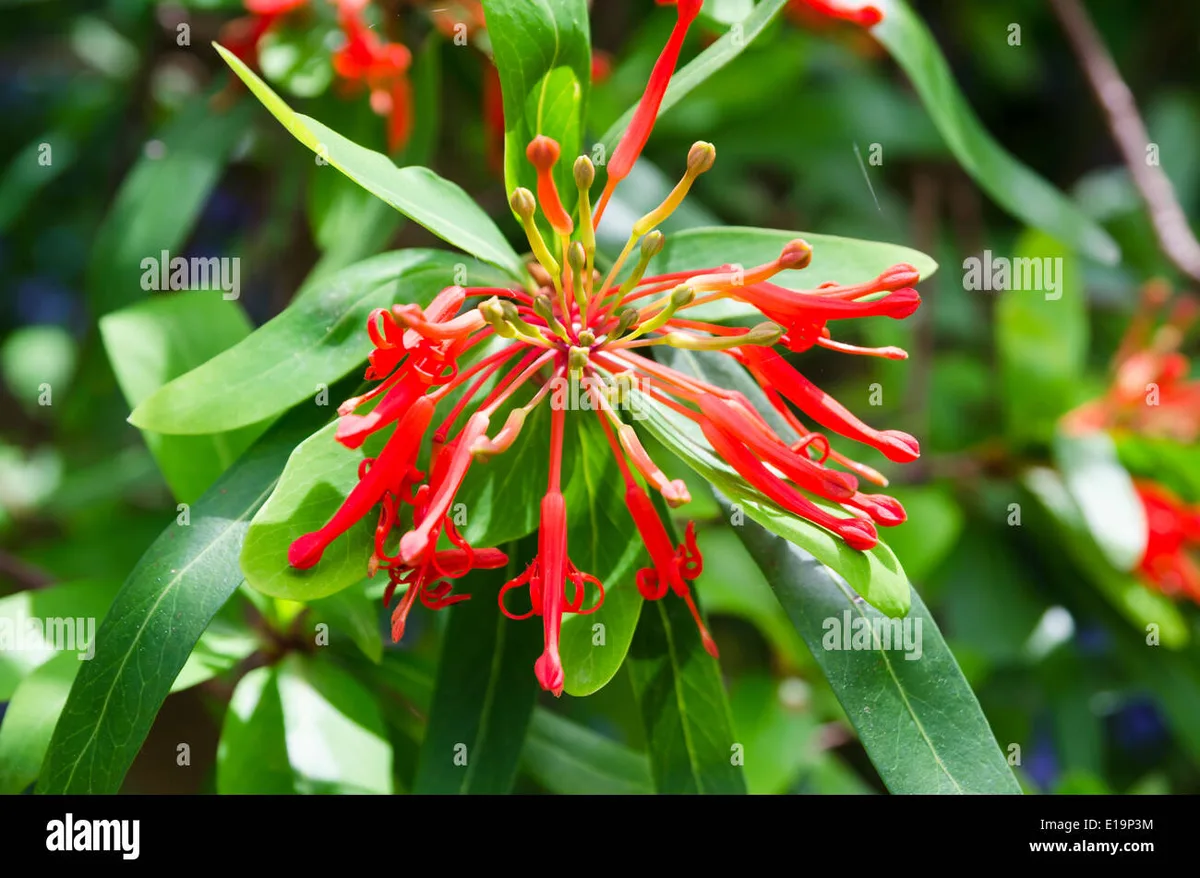
An upright, semi-evergreen shrub or small tree, with leathery, narrowly-lance-shaped leaves and clusters of tubular, orange-red flowers in late spring and early summer
Scientific classification
- Species
- Chilean fire bush 'Inca Flame' (Embothrium coccineum 'Inca Flame')
- Genus
- Embothrium
- Family
- Proteaceae
- Information to be completed
- Toxicity
- Shrubs · Trees
- Plant type
- 4-8 metres
- Height
- 2.5-4 metres
- Spread
- Semi evergreen
- Foliage
- Bushy
- Habit
- Spring · Summer · Autumn · Winter
- Season of interest
- Full sun · Partial shade
- Sunlight
- Information to be completed
- Ideal temperature









Chilean fire bush 'Inca Flame' pictures
Distribution of Chilean fire bush 'Inca Flame'
Distribution map
- Native
- Introduced
- Cultivated
Source:WCVP v16 · Royal Botanic Gardens, Kew · CC BY 3.0 · Boundaries:WGSRPD / TDWG
Chilean fire bush 'Inca Flame' care guide
- Moderate regular watering, avoid prolonged drought and stagnant waterlogging
- Watering
- Full sun · Partial shade
- Sunlight

Watering
Moderate regular watering, avoid prolonged drought and stagnant waterlogging
Fertilizing
 Fertilizing
Balanced perennial feed every four weeks spring through summer growth
Pruning
 Pruning
Little pruning is needed. Remove diseased, damaged, crowded or crossing shoots and unwanted growth. Timing depends on the plant: generally late winter or early spring; plants prone to bleeding and deciduous magnolias need different timing, and deciduous azaleas and lilacs are pruned after flowering.
Propagation
 Propagation
Propagate by semi-hardwood cuttings in mid-summer and root with bottom heat. Suckers can be removed in late winter
Growing
 Growing
Grows well in a fertile, humus-rich, neutral to acid soil. Hardier than the species but may still require shelter from cold, drying winds. A useful woodland plant
Common pests and diseases
Diseases
May be susceptible to honey fungus
Pests
May be susceptible to glasshouse red spider mite
Explore the plant health library →




