
sword lily 'Trader Horn'
Also known as: Information to be completed
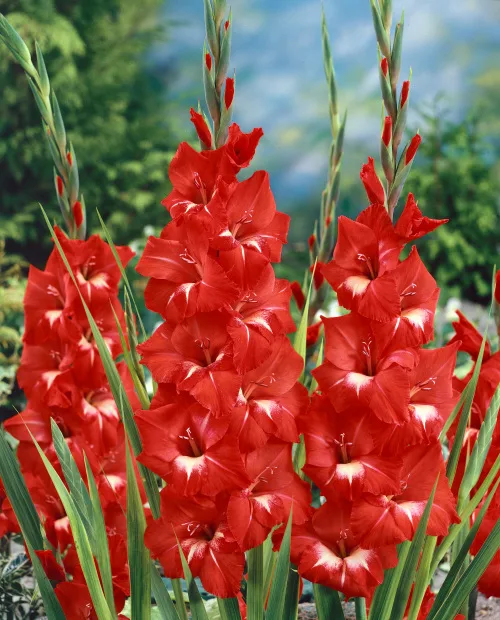
A tall plant with sword-shaped leaves and dense spikes of bright red flowers to 14cm wide, the lower petals with a white mark
Scientific classification
- Species
- sword lily 'Trader Horn' (Gladiolus 'Trader Horn')
- Genus
- Gladiolus
- Family
- Iridaceae
- Order
- Asparagales
- Class
- Liliopsida
- Phylum
- Tracheophyta
- Ornamental bulbs, not to be eaten. Wear gloves and other protective equipment when handling]
- Toxicity
- Bulbs
- Plant type
- 0.5-1 metres
- Height
- 0-0.1 metre
- Spread
- Deciduous
- Foliage
- Bushy
- Habit
- Spring · Summer
- Season of interest
- Full sun
- Sunlight
- Information to be completed
- Ideal temperature









sword lily 'Trader Horn' pictures
Toxicity
Ornamental bulbs, not to be eaten. Wear gloves and other protective equipment when handling]
sword lily 'Trader Horn' care guide
- Even soil moisture while foliage matures, cut water after bloom fade
- Watering
- Full sun
- Sunlight

Watering
Even soil moisture while foliage matures, cut water after bloom fade
Fertilizing
 Fertilizing
Bulb specific low-nitrogen feed biweekly budding development stage
Pruning
 Pruning
No pruning required
Propagation
 Propagation
Propagate by separating cormlets when dormant
Growing
 Growing
Plant 10 to 16cm deep on a bed of sharp sand in fertile, well-drained soil. Lift when foliage dies back, discard old corms and store new corms in a dry frost-free place until planting in the spring. In milder areas a thick dry winter mulch may suffice
Common pests and diseases
Diseases
May be susceptible to gladiolus corm rot, grey moulds (Botrytis), Fusarium bulb rot, gladiolus core rot, gladiolus dry rot, gladiolus scab and neck rot, fungal leaf spot, and virus diseases
Pests
May be susceptible to gladiolus thrip, aphids and slugs
Explore the plant health library →




