
Virginia knotweed 'Compton's Red'
Also known as: knotweed 'Compton's Red'
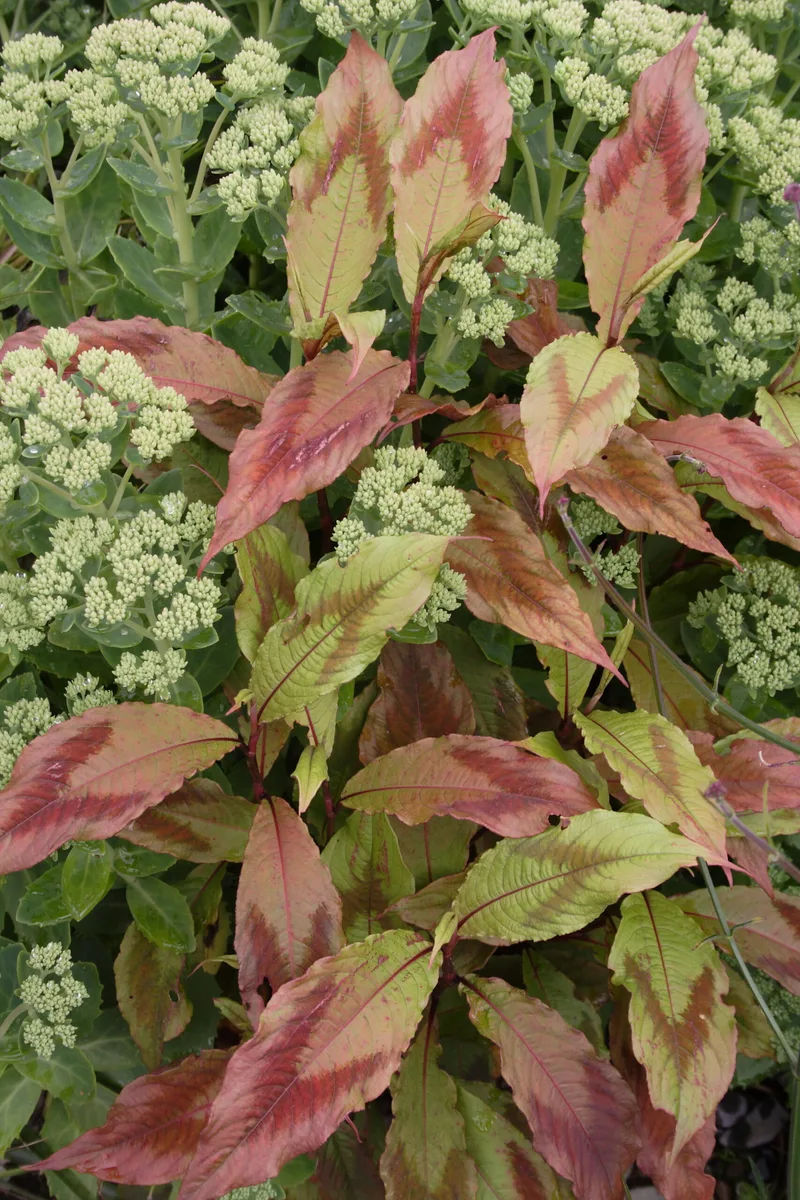
A clump-forming, deciduous herbaceous perennial to 80cm with chunky, ovate to elliptic olive-green leaves, with a chocolate-brown chevron, red veins and red flush. Spikes of red flowers appear in late summer and early autumn. Suitable for the middle of a flower border. Copes well in dry shade
Scientific classification
- Species
- Virginia knotweed 'Compton's Red' (Persicaria filiformis 'Compton's Red')
- Genus
- Persicaria
- Family
- Polygonaceae
- Order
- Caryophyllales
- Class
- Magnoliopsida
- Phylum
- Magnoliophyta
- Information to be completed
- Toxicity
- Herbaceous Perennial
- Plant type
- 0.5-1 metres
- Height
- 0.5-1 metres
- Spread
- Deciduous
- Foliage
- Clump forming
- Habit
- Spring · Summer · Autumn
- Season of interest
- Full sun · Partial shade
- Sunlight
- Information to be completed
- Ideal temperature









Virginia knotweed 'Compton's Red' pictures
Distribution of Virginia knotweed 'Compton's Red'
Distribution map
- Native
- Introduced
- Cultivated
Source:WCVP v16 · Royal Botanic Gardens, Kew · CC BY 3.0 · Boundaries:WGSRPD / TDWG
Virginia knotweed 'Compton's Red' care guide
- Keep soil continuously moist, tolerates lightly waterlogged planting sites
- Watering
- Full sun · Partial shade
- Sunlight

Watering
Keep soil continuously moist, tolerates lightly waterlogged planting sites
Fertilizing
 Fertilizing
Mild balanced liquid feed administered once per growing month
Pruning
 Pruning
Cut back old, flowered stems to the ground in autumn
Propagation
 Propagation
Propagate by division in spring or autumn
Growing
 Growing
Grow in moisture-retentive but well-drained soil in sun or partial shade. Robust in dry shade
Common pests and diseases
Diseases
Generally disease-free
Pests
Generally pest-free but may be susceptible to slugs and snails
Explore the plant health library →




