
Anthurium Million Flowers Red ('Ryn2010043')
Also known as: Information to be completed
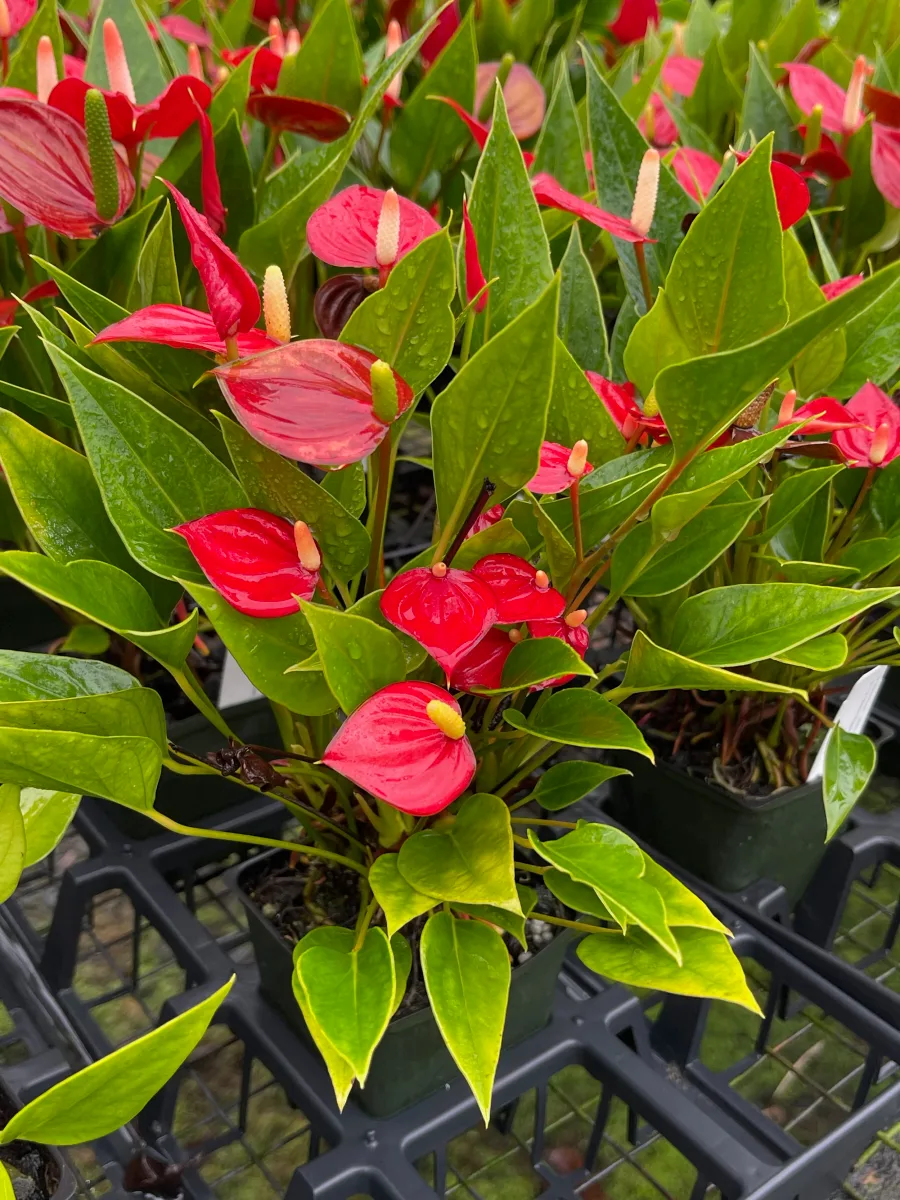
A very free-flowering, tender, epiphytic evergreen perennial about 50cm tall, with glossy dark green, arrow-shaped, leaves to 50cm long, on tall leaf-stalks, and glossy, heart-shaped, bright, rich red spathe flowers with yellow spike-like spadices, produced through the year
Scientific classification
- Species
- Anthurium Million Flowers Red ('Ryn2010043') (Anthurium Million Flowers Red ('Ryn2010043'))
- Genus
- Anthurium
- Family
- Araceae
- Order
- Alismatales
- Class
- Liliopsida
- Phylum
- Magnoliophyta
- TOXIC if eaten; skin/eye irritant. Wear gloves and other protective equipment when handling
- Toxicity
- Conservatory Greenhouse · Houseplants
- Plant type
- Information to be completed
- Height
- Information to be completed
- Spread
- Evergreen
- Foliage
- Clump forming
- Habit
- Spring · Summer · Autumn · Winter
- Season of interest
- Partial shade
- Sunlight
- Information to be completed
- Ideal temperature









Anthurium Million Flowers Red ('Ryn2010043') pictures
Toxicity
TOXIC if eaten; skin/eye irritant. Wear gloves and other protective equipment when handling
Anthurium Million Flowers Red ('Ryn2010043') care guide
- Moderate regular watering, allowing brief slight drying between soakings
- Watering
- Partial shade
- Sunlight

Watering
Moderate regular watering, allowing brief slight drying between soakings
Fertilizing
 Fertilizing
Balanced perennial feed every four weeks from spring through summer
Pruning
 Pruning
Remove dead leaves or flower stems at the base
Propagation
 Propagation
Propagate by division, stem or rhizome cuttings and offsets in spring or summer
Growing
 Growing
Grow indoors in bright, indirect light, epiphytically or using an acidic potting mix of two parts ericaceous peat-free compost, one part perlite and one part orchid bark. Water freely and apply an orchid fertiliser every 2 weeks from spring to autumn. Provide high humidity by placing the container on a tray of moist gravel or pebbles. Water sparingly in winter, and keep above 18°C. See Anthurium for further advice
Common pests and diseases
Diseases
May be susceptible to root rot from overwatering
Pests
May be susceptible to mealybugs and scale insects
Explore the plant health library →




