
Camassia leichtlinii subsp. suksdorfii 'Blauwe Donau'
Also known as: Information to be completed
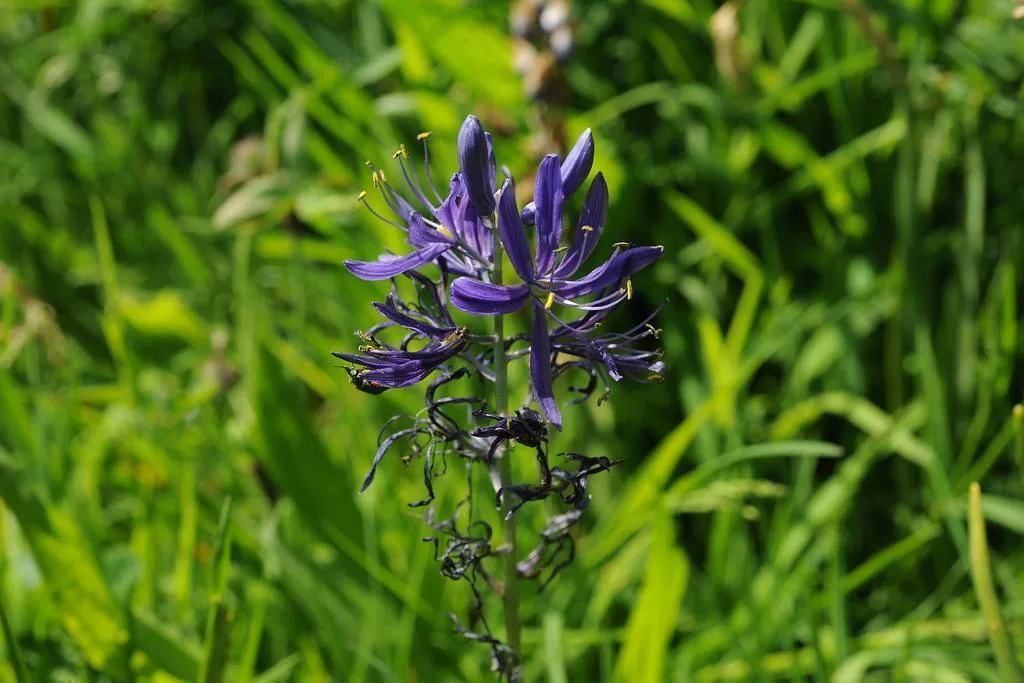
A bulbous perennial to 1.2m high, with linear, strap-shaped green leaves. Clusters of starry, soft violet-blue flowers are held on flowering spikes high above the foliage, and open in sequence from the bottom to the top of the stem in mid to late spring
Scientific classification
- Species
- Camassia leichtlinii subsp. suksdorfii 'Blauwe Donau' (Camassia leichtlinii subsp. suksdorfii 'Blauwe Donau')
- Genus
- Camassia
- Family
- Asparagaceae
- Order
- Asparagales
- Class
- Liliopsida
- Phylum
- Magnoliophyta
- Ornamental bulbs - not to be eaten. Wear gloves and other protective equipment when handling
- Toxicity
- Bulbs
- Plant type
- 1-1.5 metres
- Height
- 0.1-0.5 metres
- Spread
- Deciduous
- Foliage
- Clump forming · Columnar upright
- Habit
- Spring · Summer
- Season of interest
- Full sun · Partial shade
- Sunlight
- Information to be completed
- Ideal temperature









Camassia leichtlinii subsp. suksdorfii 'Blauwe Donau' pictures
Distribution of Camassia leichtlinii subsp. suksdorfii 'Blauwe Donau'
Distribution map
- Native
- Introduced
- Cultivated
Source:WCVP v16 · Royal Botanic Gardens, Kew · CC BY 3.0 · Boundaries:WGSRPD / TDWG
Toxicity
Ornamental bulbs - not to be eaten. Wear gloves and other protective equipment when handling
Camassia leichtlinii subsp. suksdorfii 'Blauwe Donau' care guide
- Moist soil during active growth, then reduce watering after foliage yellows
- Watering
- Full sun · Partial shade
- Sunlight

Watering
Moist soil during active growth, then reduce watering after foliage yellows
Fertilizing
 Fertilizing
Light bulb fertilizer at emergence and again after flowering
Pruning
 Pruning
Deadhead as flowers fade
Propagation
 Propagation
Propagate by seed sown as soon as ripe, or by division, removing offsets from the parent bulb when dormant in summer
Growing
 Growing
Plant bulbs in autumn, 10-15cm deep in fertile, humus-rich, moist but well-drained soil. Will grow in sun or partial shade, but does not tolerate waterlogging. Mulch in winter in cold areas. May have the potential to become a nuisance due to prolific self-seeding if not managed well
Common pests and diseases
Diseases
Generally disease-free
Pests
Generally pest-free
Explore the plant health library →




