
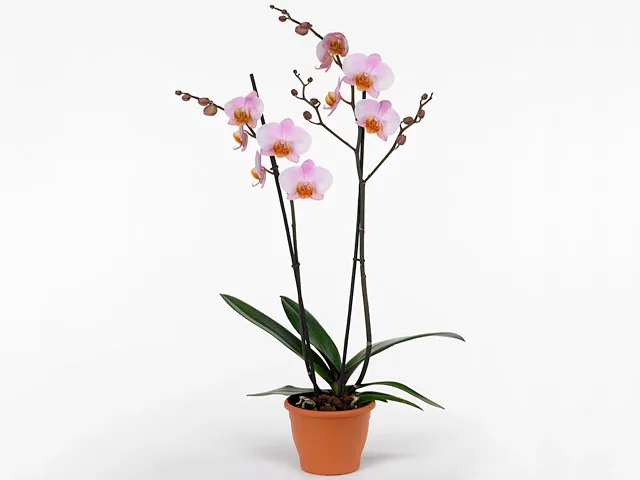
Phalaenopsis Anthura Chengdu ('Phalbisyk')
Also known as: Information to be completed
Medium sized, evergreen, upright growing epiphytic orchid. Broadly oval, green or dark green leaves up to 40 cm long emerge from the centre of the plant and are main storage of water and nutrients. New flowering stems emerge from the base of older leaves. Long lasting flowers are carried on branched racemes up to 60 cm tall. Flowers are bilaterally symmetrical, pale pink or yellow, with or without dark markings, measuring up to 10 cm across.
Scientific classification
- Species
- Phalaenopsis Anthura Chengdu ('Phalbisyk') (Phalaenopsis Anthura Chengdu ('Phalbisyk'))
- Genus
- Phalaenopsis
- Family
- Orchidaceae
- Order
- Asparagales
- Class
- Liliopsida
- Phylum
- Magnoliophyta
- Information to be completed
- Toxicity
- Conservatory Greenhouse · Houseplants
- Plant type
- 0.1-0.5 metres
- Height
- 0.1-0.5 metres
- Spread
- Evergreen
- Foliage
- Columnar upright
- Habit
- Spring · Summer · Autumn · Winter
- Season of interest
- Partial shade
- Sunlight
- Information to be completed
- Ideal temperature









Phalaenopsis Anthura Chengdu ('Phalbisyk') pictures
Phalaenopsis Anthura Chengdu ('Phalbisyk') care guide
- Keep potting medium lightly moist, airy, and never stagnant
- Watering
- Partial shade
- Sunlight

Watering
Keep potting medium lightly moist, airy, and never stagnant
Fertilizing
 Fertilizing
Half-strength orchid feed every two to three weeks in active growth
Pruning
 Pruning
No pruning required. Cut back flowered stem to lower node to encourage further flowering.
Propagation
 Propagation
 by seed is only possible in controlled laboratory environment. Mature plants may produce sideshoots (keiki) which may be removed and potted separately into orchid propagation mix when the new roots are at least 2cm long
Growing
 Growing
Grow in an open bark-based orchid compost. Provide enough bright filtered light, but keep away from direct mid-day sunlight or heating source. Ideal temperatures are around 17°C at night and 20 - 25 °C during day. Mist aerial roots regularly and water the plant when almost dry - pale, silvery roots are a good indication when to water. Orchid fertiliser can be applied regularly throughout the season. See Phalaenopsis cultivation.
Common pests and diseases
Diseases
Generally disease-free; avoid watering centre of the leaf crown, to prevent bacterial rots
Pests
May be susceptible to mealybugs, aphids and scale insects.
Explore the plant health library →




