
Queen Victoria's dendrobium
Also known as: Information to be completed
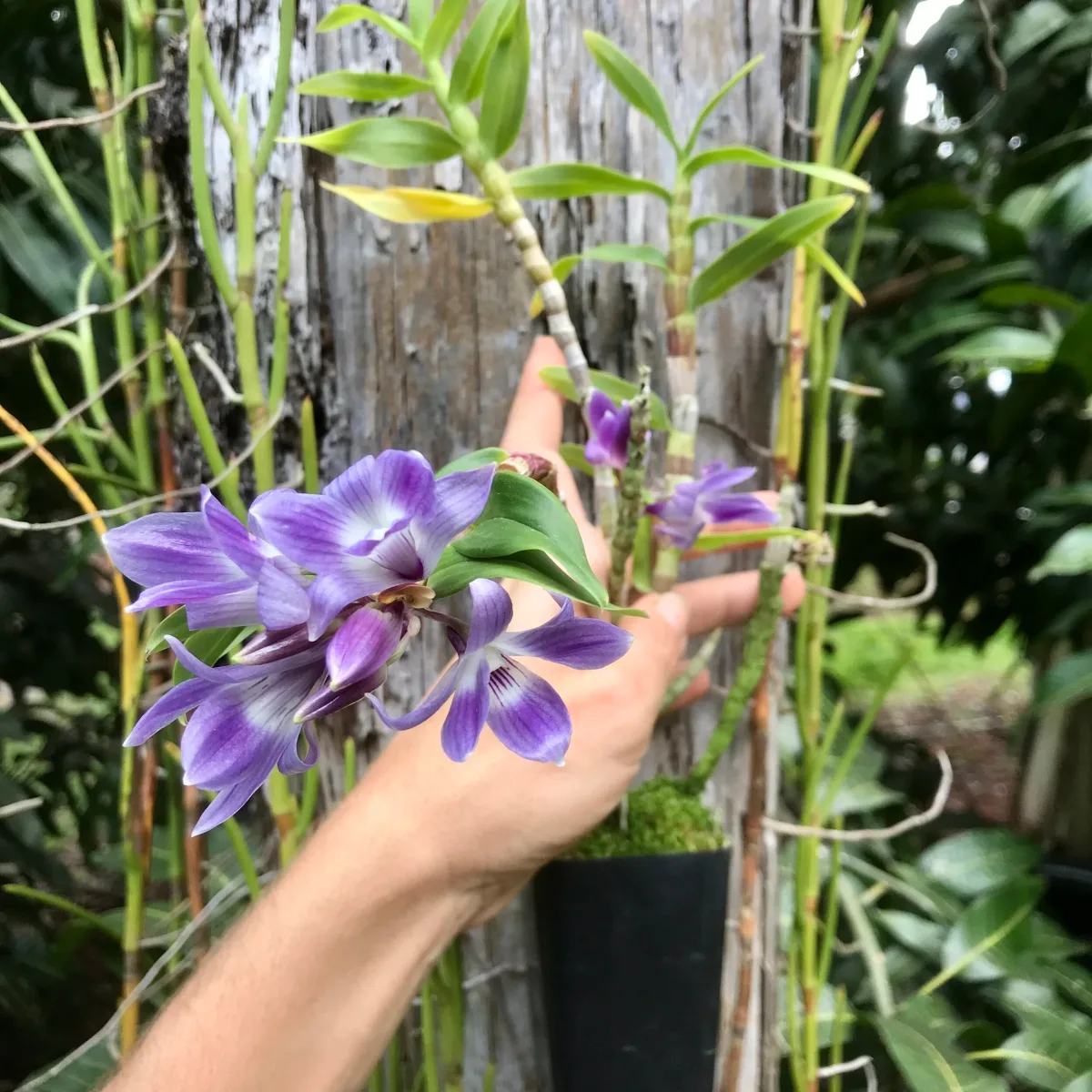
A medium-sized, epiphytic orchid with long, pendulous, cane-like stems, varying in length from 20cm to 1.2m. Each stem is covered in alternate, papery sheaths, carrying lance-shaped, 6cm long leaves. Short flowering stems carry a cluster of one to three flowers, appearing from the nodes of mature, leafless canes. Each flower is 3-4cm large, pale purple or blue, with white centre.
Scientific classification
- Species
- Queen Victoria's dendrobium (Dendrobium victoriae-reginae)
- Genus
- Dendrobium
- Family
- Orchidaceae
- Order
- Asparagales
- Class
- Liliopsida
- Phylum
- Magnoliophyta
- Information to be completed
- Toxicity
- Conservatory Greenhouse
- Plant type
- 0.1-0.5 metres
- Height
- 0.1-0.5 metres
- Spread
- Semi evergreen
- Foliage
- Columnar upright · Pendulous weeping · Tufted
- Habit
- Spring · Summer · Autumn · Winter
- Season of interest
- Partial shade · Full sun
- Sunlight
- Information to be completed
- Ideal temperature









Queen Victoria's dendrobium pictures
Distribution of Queen Victoria's dendrobium
Distribution map
- Native
- Introduced
- Cultivated
Source:WCVP v16 · Royal Botanic Gardens, Kew · CC BY 3.0 · Boundaries:WGSRPD / TDWG
Queen Victoria's dendrobium care guide
- Keep medium lightly moist with excellent aeration
- Watering
- Partial shade · Full sun
- Sunlight

Watering
Keep medium lightly moist with excellent aeration
Fertilizing
 Fertilizing
Half-strength orchid feed every few weeks in growth
Pruning
 Pruning
No pruning required. Remove spent flowers as necessary, but do not cut the whole cane unless completely shrivelled. Oldest canes may be removed as long as there are enough, younger, thick, leaf-bearing canes on the plant.
Propagation
 Propagation
 by seed is only possible in controlled laboratory environment. Mature plants may be divided when the plant overgrows the pot. Sideshoots (keiki) may develop on older canes - remove and pot them into sphagnum moss when the new roots are at least 2cm long.
Growing
 Growing
Plants are best grown mounted on cork bark or wood if sufficient humidity can be provided. Alternatively, grow in a basket in an epiphytic, medium grade, bark-based potting mix with added perlite, moss, or coir. As with many orchids, they grow best when the roots are slightly restricted. Therefore, avoid over-potting or frequent root disturbance. Provide bright light and sufficient humidity by misting regularly throughout the growing season. Reduce watering and feeding during the rest period in winter. For a successfull cultivation, the plant requires good air movement, and a significant drop of temperature between day and night time. See indoor orchid cultivation
Common pests and diseases
Diseases
Generally disease-free.
Pests
May be susceptible to scale insects, aphids, mealybugs and red spider mite.
Explore the plant health library →




