
passion flower 'Amethyst'
Also known as: Information to be completed
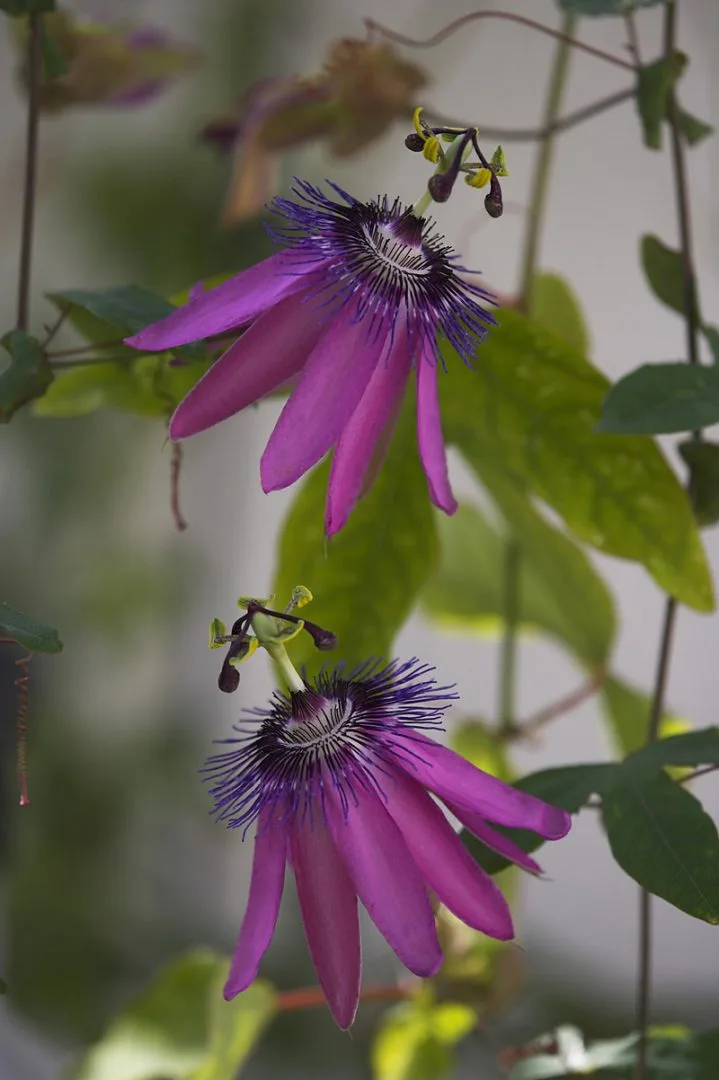
Vigorous evergreen climber about 4m tall, with deeply 3-lobed rich green leaves, and purple to purple-blue flowers 10cm across, with green anthers, tepals becoming reflexed with age, and deep purple coronal filaments, flowering in late summer and autumn, followed by orange fruit to 6cm long. The pulp in the fruits only can be eaten when they are fully ripe and yellow-orange. Unripe fruit is toxic
Scientific classification
- Species
- passion flower 'Amethyst' (Passiflora 'Amethyst')
- Genus
- Passiflora
- Family
- Passifloraceae
- Fruit are ornamental - not to be eaten. Wear gloves and other protective equipment when handling
- Toxicity
- Climber Wall Shrub · Conservatory Greenhouse
- Plant type
- 2.5-4 metres
- Height
- 0.5-1 metres
- Spread
- Evergreen
- Foliage
- Climbing
- Habit
- Spring · Summer · Autumn · Winter
- Season of interest
- Full sun · Partial shade
- Sunlight
- Information to be completed
- Ideal temperature









passion flower 'Amethyst' pictures
Distribution of passion flower 'Amethyst'
Distribution map
Information to be completed
Information to be completed
Culture
Information to be completed
Toxicity
Fruit are ornamental - not to be eaten. Wear gloves and other protective equipment when handling
Quick identification of passion flower 'Amethyst'
Information to be completed
passion flower 'Amethyst' care guide
- Regular deep watering, keep root zone damp in hot summer weather
- Watering
- Full sun · Partial shade
- Sunlight
- Information to be completed
- Ideal temperature

Watering
Regular deep watering, keep root zone damp in hot summer weather
Fertilizing
 Fertilizing
High-potash vine feed every two weeks from spring to mid-autumn
Pruning
 Pruning
Routine pruning is unnecessary; shorten overlong shoots to fit the available space. For last-year flowering growth, prune after flowering; for current-year flowering growth, prune in late winter or spring. This guidance is for established plants.
Propagation
 Propagation
Propagate by seed, semi-hardwood cuttings or by layering in spring or autumn
Growing
 Growing
Grow in a conservatory or frost free greenhouse in a container of loam-based potting compost in full light, with shade from hot sun. Suited to outdoor cultivation in summer for mild counties only. See passion flower cultivation
People also ask
Information to be completed
Common pests and diseases
Diseases
May be susceptible to honey fungus (rarely) and a virus
Pests
May be susceptible to glasshouse red spider mite, scale insects and glasshouse whitefly
Explore the plant health library →




