
geranium 'King Edmund'
Also known as: Information to be completed
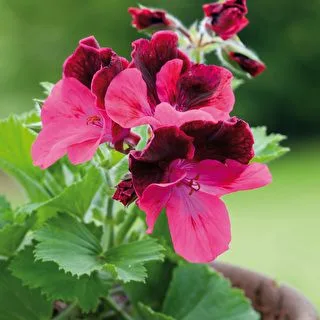
A bushy, evergreen regal perennial pelargonium, with rounded mid-green deeply serrated leaves and large trumpet-shaped single pink flowers with maroon upper petals and magenta lower petals in summer.
Scientific classification
- Species
- geranium 'King Edmund' (Pelargonium 'King Edmund')
- Genus
- Pelargonium
- Family
- Geraniaceae
- Order
- Geraniales
- Class
- Magnoliopsida
- Phylum
- Magnoliophyta
- Information to be completed
- Toxicity
- Shrubs
- Plant type
- 0.1-0.5 metres
- Height
- 0.1-0.5 metres
- Spread
- Evergreen
- Foliage
- Bushy
- Habit
- Spring · Summer · Autumn · Winter
- Season of interest
- Partial shade · Full sun
- Sunlight
- Information to be completed
- Ideal temperature









geranium 'King Edmund' pictures
geranium 'King Edmund' care guide
- Evenly moist pot soil, drain excess water to prevent stem rot issues
- Watering
- Partial shade · Full sun
- Sunlight

Watering
Evenly moist pot soil, drain excess water to prevent stem rot issues
Fertilizing
 Fertilizing
Diluted geranium bloom feed biweekly full summer flowering phase
Pruning
 Pruning
Pinch back tips of shoots in spring or early summer and deadhead to promote flowering.
Propagation
 Propagation
Propagate from softwood cuttings from spring to autumn.
Growing
 Growing
Will grow well in a frost-free environment, in well-drained fertile neutral to alkaline soil, preferably in full sun but will tolerate some partial shade, in borders or containers. Irrigate moderately from spring to summer, and sparingly in winter allowing the compost to dry up between waterings. Apply a balanced liquid fertilizer during the growing season and switch to a high potassium fertilizer when flowering starts. Overwinter in containers before the first frost in autumn. See Pelargonium cultivation for further advice.
Common pests and diseases
Diseases
May be susceptible to Pelargonium rust, Pelargonium virus, Leafy gall.
Pests
May be susceptible to Thrips, vine weevil, Leafhopper, Root mealybugs, Whitefly.
Explore the plant health library →




