
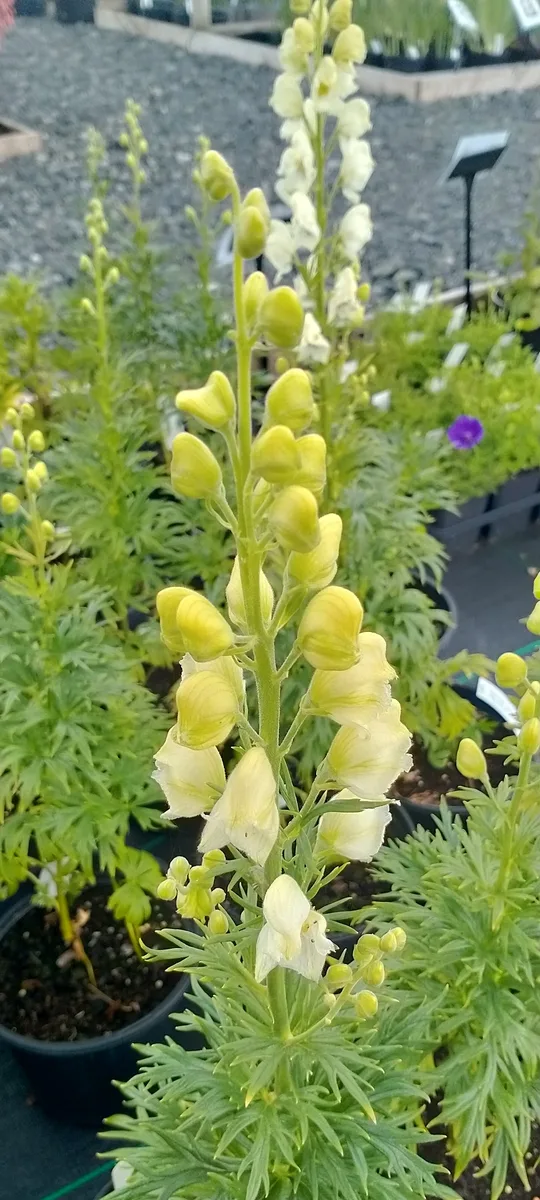
purple wolf's bane 'Grandiflorum Album'
Also known as: Information to be completed
A clump-forming, herbaceous perennial to about 1.2m tall, with deeply divided, glossy dark green leaves and widely-branched, upright spikes which produce racemes of evenly spaced, hooded, white flowers, opening from green buds, in mid to late summer
Scientific classification
- Species
- purple wolf's bane 'Grandiflorum Album' (Aconitum × cammarum 'Grandiflorum Album')
- Genus
- Aconitum
- Family
- Ranunculaceae
- Order
- Ranunculales
- Class
- Magnoliopsida
- Phylum
- Magnoliophyta
- TOXIC if eaten, avoid skin contact. Wear gloves and other protective equipment when handling]
- Toxicity
- Herbaceous Perennial
- Plant type
- Information to be completed
- Height
- Information to be completed
- Spread
- Deciduous
- Foliage
- Clump forming
- Habit
- Spring · Summer · Autumn
- Season of interest
- Full sun · Partial shade
- Sunlight
- Information to be completed
- Ideal temperature









purple wolf's bane 'Grandiflorum Album' pictures
Distribution of purple wolf's bane 'Grandiflorum Album'
Distribution map
- Native
- Introduced
- Cultivated
Source:WCVP v16 · Royal Botanic Gardens, Kew · CC BY 3.0 · Boundaries:WGSRPD / TDWG
Toxicity
TOXIC if eaten, avoid skin contact. Wear gloves and other protective equipment when handling]
purple wolf's bane 'Grandiflorum Album' care guide
- Moderate regular watering, avoid prolonged drought or waterlogging
- Watering
- Full sun · Partial shade
- Sunlight

Watering
Moderate regular watering, avoid prolonged drought or waterlogging
Fertilizing
 Fertilizing
Balanced feed in spring and light repeat in growth season
Pruning
 Pruning
No pruning required except cutting back dead stems; use protective gloves
Propagation
 Propagation
Propagate by division in autumn or late winter; division every few years may encourage good flowering stems, though plants may be slow to re-establish; use protective gloves
Growing
 Growing
Grows best in deep, cool, moisture-retentive soil in partial shade, but will also tolerate most soils and full sun if soil is humus-rich and protected with mulch to ensure that it is moist throughout the growing season; use protective gloves
Common pests and diseases
Diseases
May be susceptible to fungal stem rot, powdery mildews, and Verticillium wilt
Pests
Generally pest-free but may be susceptible to aphids
Explore the plant health library →




