
Physostegia virginiana 'Rosea'
Also known as: Information to be completed
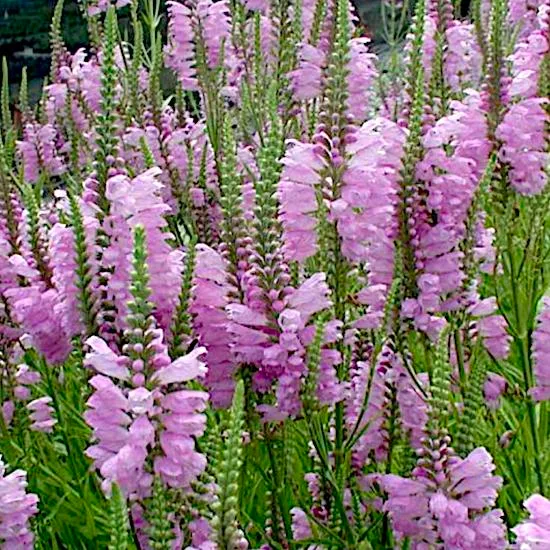
An herbaceous perennial to 75cm tall, with erect, square stems bearing lance-shaped, toothed leaves. From midsummer to early autumn it produces pale, violet-pink, tubular flowers held in short, upright spikes; the flowers are good for cutting. The common name refers to individual blooms, which will stay in position if moved around on their stalks
Scientific classification
- Species
- Physostegia virginiana 'Rosea' (Physostegia virginiana 'Rosea')
- Genus
- Physostegia
- Family
- Lamiaceae
- Order
- Lamiales
- Class
- Magnoliopsida
- Phylum
- Magnoliophyta
- Information to be completed
- Toxicity
- Herbaceous Perennial
- Plant type
- 0.5-1 metres
- Height
- 0.1-0.5 metres
- Spread
- Deciduous
- Foliage
- Clump forming
- Habit
- Spring · Summer · Autumn
- Season of interest
- Full sun · Partial shade
- Sunlight
- Information to be completed
- Ideal temperature









Physostegia virginiana 'Rosea' pictures
Distribution of Physostegia virginiana 'Rosea'
Distribution map
- Native
- Introduced
- Cultivated
Source:WCVP v16 · Royal Botanic Gardens, Kew · CC BY 3.0 · Boundaries:WGSRPD / TDWG
Physostegia virginiana 'Rosea' care guide
- Moderate regular watering, allowing brief slight drying between soakings
- Watering
- Full sun · Partial shade
- Sunlight

Watering
Moderate regular watering, allowing brief slight drying between soakings
Fertilizing
 Fertilizing
Balanced perennial feed every four weeks from spring through summer
Pruning
 Pruning
Cut back old stems in winter
Propagation
 Propagation
Propagate by sowing seed in containers in a cold frame in autumn, or by division in early spring
Growing
 Growing
Grow in fertile, reliably moist soil in full sun or partial shade
Common pests and diseases
Diseases
May be susceptible to fungal and bacterial rots
Pests
May be susceptible to slugs and snails
Explore the plant health library →




