
long-podded whitlow grass
Also known as: Information to be completed
A cushion-forming evergreen perennial to 8cm in height, with dense rosettes of grey-hairy, obovate leaves and bright yellow flowers 10mm across borne in short racemes on slender stems just above the foliage
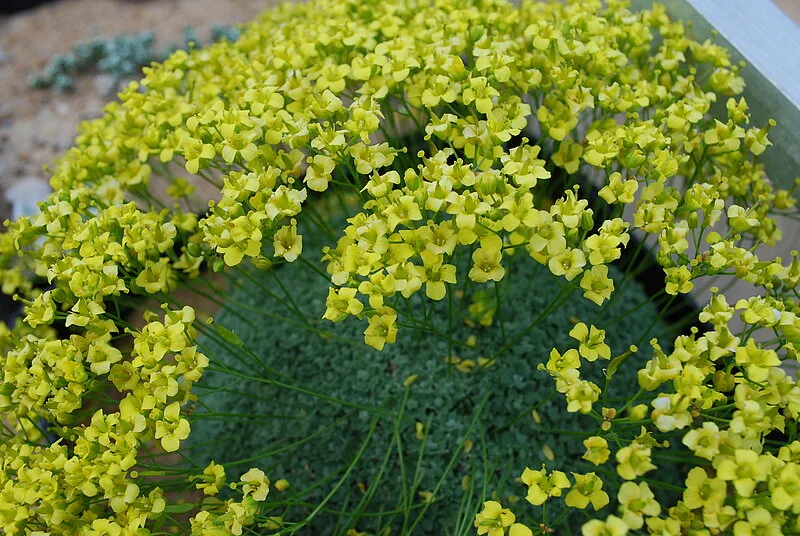
Scientific classification
- Species
- long-podded whitlow grass (Draba longisiliqua)
- Genus
- Draba
- Family
- Brassicaceae
- Order
- Brassicales
- Class
- Magnoliopsida
- Phylum
- Magnoliophyta
- Information to be completed
- Toxicity
- Alpine Rockery
- Plant type
- Up to 10 cm
- Height
- 0.1-0.5 metres
- Spread
- Evergreen
- Foliage
- Matforming
- Habit
- Spring · Summer · Autumn · Winter
- Season of interest
- Full sun
- Sunlight
- Information to be completed
- Ideal temperature









long-podded whitlow grass pictures
Distribution of long-podded whitlow grass
Distribution map
Caucasus
long-podded whitlow grass care guide
- Moderate regular watering, avoid prolonged drought and stagnant waterlogging
- Watering
- Full sun
- Sunlight

Watering
Moderate regular watering, avoid prolonged drought and stagnant waterlogging
Fertilizing
 Fertilizing
Balanced perennial feed every four weeks spring through summer growth
Pruning
 Pruning
No pruning required
Propagation
 Propagation
Propagate by seed sown in an open frame in autumn; they need exposure to cold to germinate. Propagate by rooting rosettes in late spring
Growing
 Growing
Grow in gritty, moist but very well-drained soil in full sun. Protect from winter wet and water carefully to avoid wetting the foliage. Usually grown in rock garden or scree, or in pots in an alpine house
Common pests and diseases
Diseases
Generally disease free
Pests
Prone to aphids and glasshouse red spider mite when grown under glass
Explore the plant health library →




