
Saxifraga 'White Pixie'
Also known as: Information to be completed
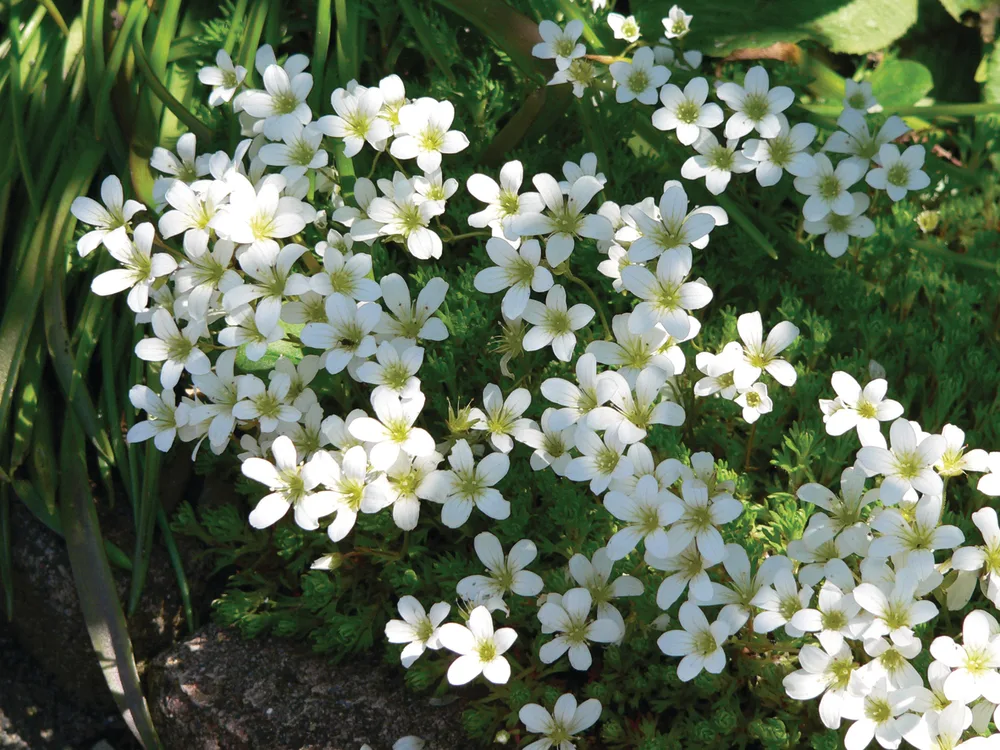
An evergreen perennial forming a low mound of small, deeply-cut, moss-like leaves arranged in rosettes. In spring and early summer, cup-shaped, white flowers appear in profusion held above the foliage on short stems
Scientific classification
- Species
- Saxifraga 'White Pixie' (Saxifraga 'White Pixie')
- Genus
- Saxifraga
- Family
- Saxifragaceae
- Information to be completed
- Toxicity
- Alpine Rockery
- Plant type
- 0.1-0.5 metres
- Height
- 0.1-0.5 metres
- Spread
- Evergreen
- Foliage
- Matforming
- Habit
- Spring · Summer · Autumn · Winter
- Season of interest
- Full sun · Partial shade
- Sunlight
- Information to be completed
- Ideal temperature









Saxifraga 'White Pixie' pictures
Distribution of Saxifraga 'White Pixie'
Distribution map
Information to be completed
Information to be completed
Culture
Information to be completed
Toxicity
Information to be completed
Quick identification of Saxifraga 'White Pixie'
Information to be completed
Saxifraga 'White Pixie' care guide
- Evenly lightly moist rockery soil, avoid full drying of root medium
- Watering
- Full sun · Partial shade
- Sunlight
- Information to be completed
- Ideal temperature

Watering
Evenly lightly moist rockery soil, avoid full drying of root medium
Fertilizing
 Fertilizing
Mild balanced alpine plant feed monthly spring through summer months
Pruning
 Pruning
No pruning required
Propagation
 Propagation
Propagate by detaching individual rosettes and rooting as cuttings
Growing
 Growing
Grow in humus-rich, moist but very well-drained, alkaline or neutral soil in light shade
People also ask
Information to be completed
Common pests and diseases
Diseases
Generally disease-free
Pests
May be susceptible to aphids, slugs, vine weevil, and glasshouse red spider mite
Explore the plant health library →




