
flame violet 'Silver Sheen'
Also known as: Information to be completed
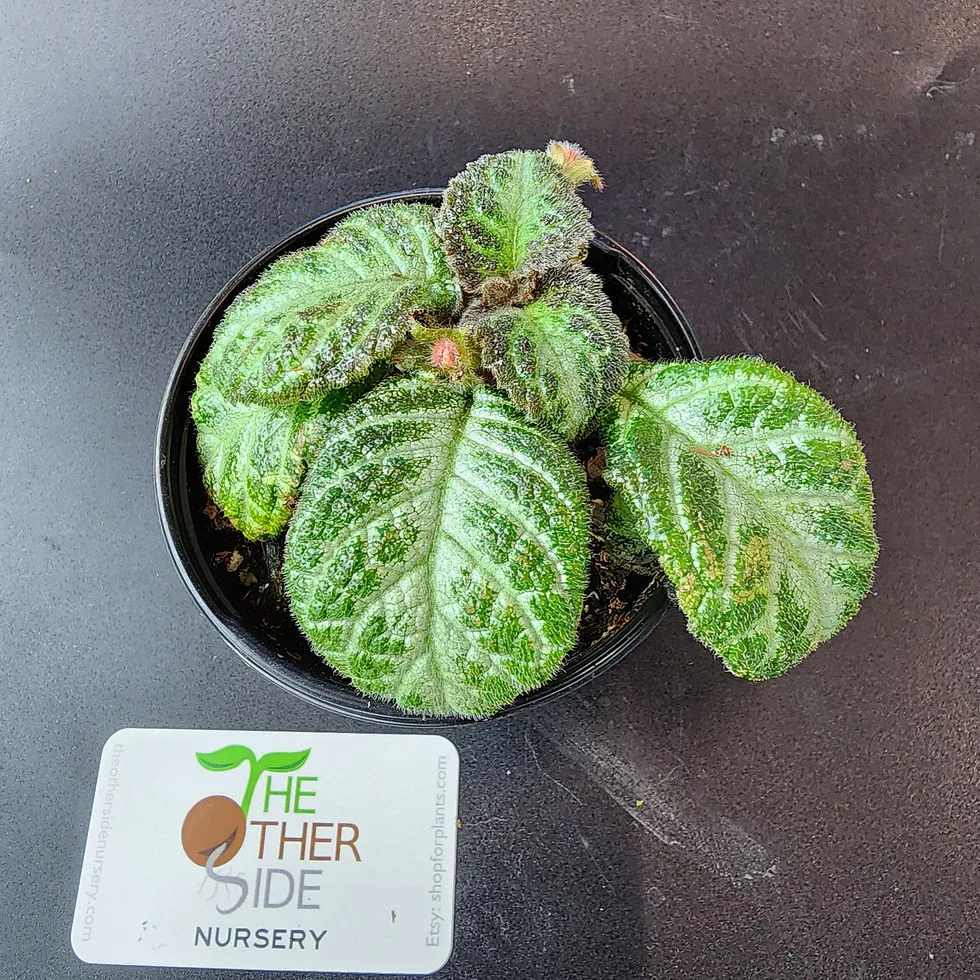
An evergreen, low-growing perennial usually grown as a houseplant with creeping stems bearing oval, wrinkled, variegated pale green to silvery leaves marked with bronze towards the margins. Funnel-shaped, red flowers appear intermittently from spring into autumn
Scientific classification
- Species
- flame violet 'Silver Sheen' (Episcia cupreata 'Silver Sheen')
- Genus
- Episcia
- Family
- Gesneriaceae
- Order
- Lamiales
- Class
- Magnoliopsida
- Phylum
- Magnoliophyta
- Information to be completed
- Toxicity
- Houseplants · Conservatory Greenhouse
- Plant type
- Up to 10 cm
- Height
- 0.5-1 metres
- Spread
- Evergreen
- Foliage
- Trailing · Bushy
- Habit
- Spring · Summer · Autumn · Winter
- Season of interest
- Partial shade
- Sunlight
- Information to be completed
- Ideal temperature









flame violet 'Silver Sheen' pictures
Distribution of flame violet 'Silver Sheen'
Distribution map
- Native
- Introduced
- Cultivated
Source:WCVP v16 · Royal Botanic Gardens, Kew · CC BY 3.0 · Boundaries:WGSRPD / TDWG
flame violet 'Silver Sheen' care guide
- Moderate regular watering, allowing brief slight drying between soakings
- Watering
- Partial shade
- Sunlight

Watering
Moderate regular watering, allowing brief slight drying between soakings
Fertilizing
 Fertilizing
Balanced perennial feed every four weeks from spring through summer
Pruning
 Pruning
No pruning required
Propagation
 Propagation
Propagate by stem cutting, by division or removing rooted runners
Growing
 Growing
Grow as a houseplant on an east or west-facing windowsill, or grow in a temperate or warm greenhouse in bright filtered light with shade from hot sun; a minimum temperature of 15°C is required. Water sparingly as compost dries in winter and in the growing season water freely allowing compost to dry out between waterings; feed fortnightly with a high-potassium fertiliser
Common pests and diseases
Diseases
May be susceptible to basal rot and grey moulds if overwatered
Pests
May be susceptible to aphids, glasshouse leafhoppers, mealybugs, Thrips, vine weevil and tarsonemid mite
Explore the plant health library →




