
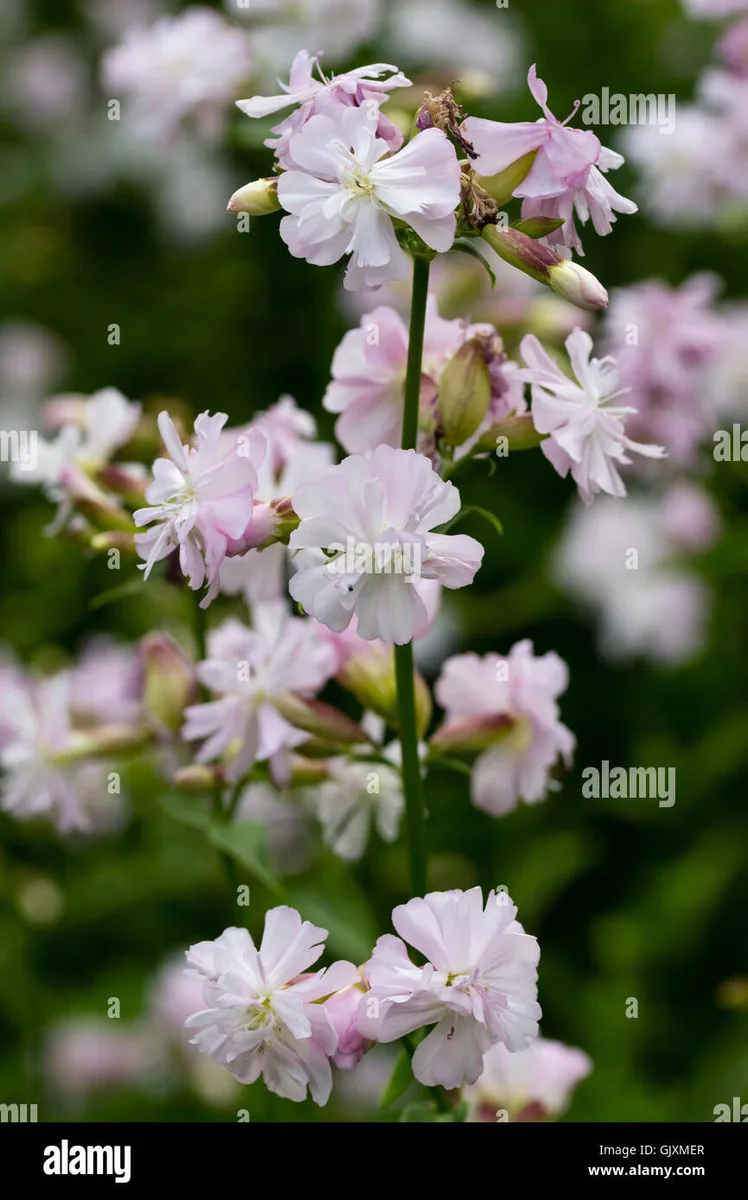
soapwort 'Rosea Plena'
Also known as: Information to be completed
A vigorous upright perennial to around 60cm high, with spreading rhizomes and narrowly ovate, rough green leaves. Clusters of fragrant, double rose-pink flowers are borne at the tips of the stems from late summer well into autumn
Scientific classification
- Species
- soapwort 'Rosea Plena' (Saponaria officinalis 'Rosea Plena')
- Genus
- Saponaria
- Family
- Caryophyllaceae
- Order
- Caryophyllales
- Class
- Magnoliopsida
- Phylum
- Tracheophyta
- Information to be completed
- Toxicity
- Herbaceous Perennial
- Plant type
- 0.5-1 metres
- Height
- 0.1-0.5 metres
- Spread
- Deciduous
- Foliage
- Clump forming
- Habit
- Spring · Summer · Autumn
- Season of interest
- Full sun
- Sunlight
- Information to be completed
- Ideal temperature









soapwort 'Rosea Plena' pictures
Distribution of soapwort 'Rosea Plena'
Distribution map
- Native
- Introduced
- Cultivated
Source:WCVP v16 · Royal Botanic Gardens, Kew · CC BY 3.0 · Boundaries:WGSRPD / TDWG
soapwort 'Rosea Plena' care guide
- Moderate irrigation, withstands brief dry spells after full establishment
- Watering
- Full sun
- Sunlight

Watering
Moderate irrigation, withstands brief dry spells after full establishment
Fertilizing
 Fertilizing
Single spring slow-release all-purpose garden fertilizer dose
Pruning
 Pruning
No pruning required
Propagation
 Propagation
Propagate by division in autumn or spring
Growing
 Growing
Grow in moderately fertile, well-drained, neutral to alkaline soil in full sun. Tolerates poor soils. May be suitable for beds and borders, but has the potential to become a nuisance and should be carefully managed to control spread
Common pests and diseases
Diseases
Generally disease-free
Pests
May be susceptible to slugs and snails
Explore the plant health library →




