
Japanese anemone 'Bowles's Pink'
Also known as: Information to be completed
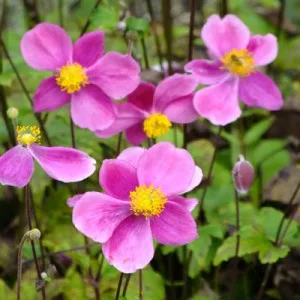
Bowles' Pink' is an erect, suckering perennial with leaves composed of three leaflets, and bowl-shaped reddish-purple flowers in late summer and autumn, the two outer tepals smaller and darker
Scientific classification
- Species
- Japanese anemone 'Bowles's Pink' (Anemone hupehensis 'Bowles's Pink')
- Genus
- Anemone
- Family
- Ranunculaceae
- Order
- Ranunculales
- Class
- Magnoliopsida
- Phylum
- Magnoliophyta
- Ingestion may cause mild stomach upset, contact may irritate skin. Wear gloves and other protective equipment when handling]
- Toxicity
- Herbaceous Perennial
- Plant type
- 0.5-1 metres
- Height
- 0.1-0.5 metres
- Spread
- Deciduous
- Foliage
- Suckering
- Habit
- Spring · Summer · Autumn
- Season of interest
- Full sun · Partial shade
- Sunlight
- Information to be completed
- Ideal temperature









Japanese anemone 'Bowles's Pink' pictures
Distribution of Japanese anemone 'Bowles's Pink'
Distribution map
- Native
- Introduced
- Cultivated
Source:WCVP v16 · Royal Botanic Gardens, Kew · CC BY 3.0 · Boundaries:WGSRPD / TDWG
Toxicity
Ingestion may cause mild stomach upset, contact may irritate skin. Wear gloves and other protective equipment when handling]
Japanese anemone 'Bowles's Pink' care guide
- Moderate regular watering, avoid prolonged drought and stagnant waterlogging
- Watering
- Full sun · Partial shade
- Sunlight

Watering
Moderate regular watering, avoid prolonged drought and stagnant waterlogging
Fertilizing
 Fertilizing
Balanced perennial feed every four weeks spring through summer growth
Pruning
 Pruning
Cut back in late autumn
Propagation
 Propagation
Propagate by division in early spring or autumn, or propagate by root cuttings
Growing
 Growing
Will grow in any garden soil but avoid excessive winter wet, dislikes being moved around. Can spread rapidly once established.
Common pests and diseases
Diseases
May be infected by powdery mildews
Pests
Prone to leaf and bud eelworms
Explore the plant health library →




