
Incarvillea delavayi 'Bees' Pink'
Also known as: Information to be completed
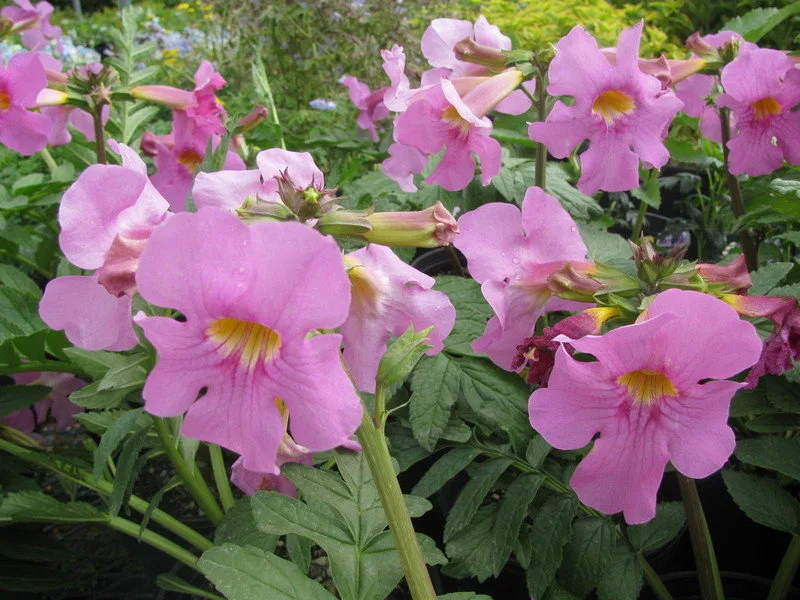
A herbaceous perennial to around 40cm high, with a basal rosette of pinnate leaves divided into pairs of coarsely toothed leaflets. Clusters of showy, tubular to funnel-shaped pale pink flowers with yellow throats are produced on upright stems in early and mid summer
Scientific classification
- Species
- Incarvillea delavayi 'Bees' Pink' (Incarvillea delavayi 'Bees' Pink')
- Genus
- Incarvillea
- Family
- Bignoniaceae
- Order
- Lamiales
- Class
- Magnoliopsida
- Phylum
- Magnoliophyta
- Information to be completed
- Toxicity
- Herbaceous Perennial
- Plant type
- 0.5-1 metres
- Height
- 0.1-0.5 metres
- Spread
- Deciduous
- Foliage
- Bushy
- Habit
- Spring · Summer · Autumn
- Season of interest
- Full sun · Partial shade
- Sunlight
- Information to be completed
- Ideal temperature









Incarvillea delavayi 'Bees' Pink' pictures
Distribution of Incarvillea delavayi 'Bees' Pink'
Distribution map
- Native
- Introduced
- Cultivated
Source:WCVP v16 · Royal Botanic Gardens, Kew · CC BY 3.0 · Boundaries:WGSRPD / TDWG
Incarvillea delavayi 'Bees' Pink' care guide
- Moderate regular watering, allowing brief slight drying between soakings
- Watering
- Full sun · Partial shade
- Sunlight

Watering
Moderate regular watering, allowing brief slight drying between soakings
Fertilizing
 Fertilizing
Balanced perennial feed every four weeks from spring through summer
Pruning
 Pruning
Cut back spent flower stems
Propagation
 Propagation
Propagate by seed, or by basal softwood cuttings in spring. Plants grown from seed may take up to three years to flower
Growing
 Growing
Grow in fertile, moist but well-drained soil, in a sunny spot but ideally with some shade in summer. Protect from excess winter wet, and mulch well in areas prone to hard frosts
Common pests and diseases
Diseases
Generally disease-free
Pests
May be susceptible to slugs
Explore the plant health library →




