
Euphorbia abyssinica
Also known as: Information to be completed
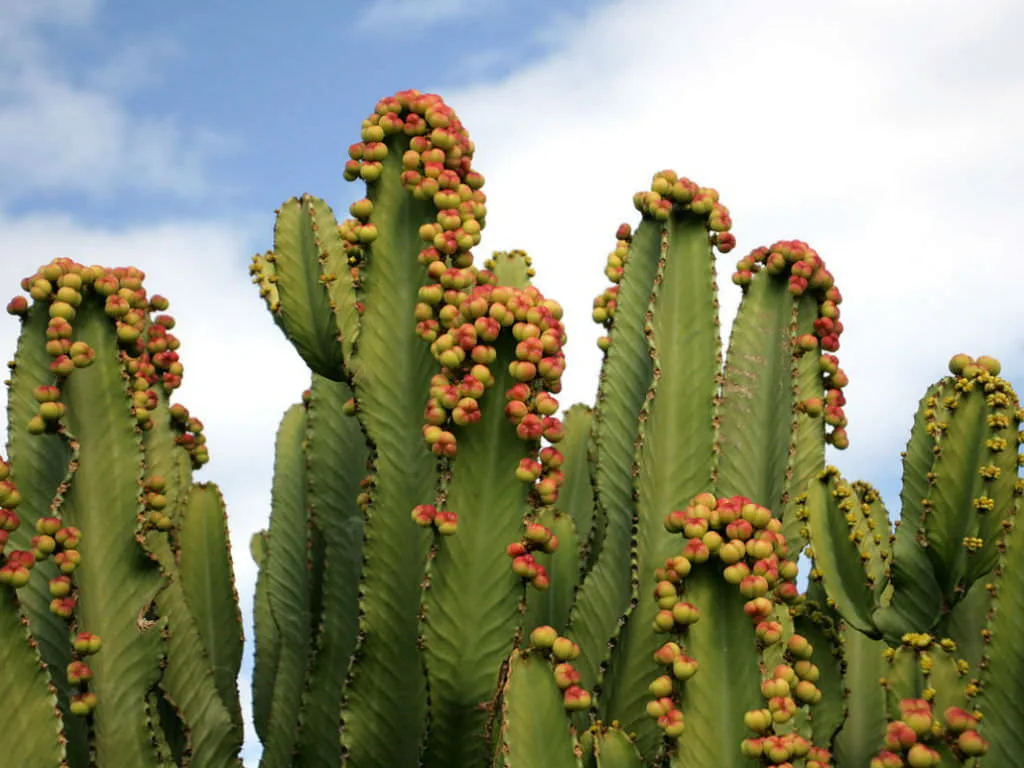
A tree-like succulent often reaching up to 10m high in its native habitat but more commonly grown as a conservatory or houseplant in this country thus restricting its growth. Individual stems are deeply ribbed with wavy rib edges that have pairs of short spines; if kept moist in a warm growing season, small, narrow leaves may emerge from the top of the stems. Small yellowish flowers are followed by fruits that start yellowish-orange before turning a reddish colour
Scientific classification
- Species
- Euphorbia abyssinica (Euphorbia abyssinica)
- Genus
- Euphorbia
- Family
- Euphorbiaceae
- Order
- Malpighiales
- Class
- Magnoliopsida
- Phylum
- Magnoliophyta
- IRRITANT to skin/eye, harmful if eaten. Wear gloves and other protective equipment when handling]
- Toxicity
- Cactus Succulent · Houseplants · Conservatory Greenhouse
- Plant type
- 8-12 metres
- Height
- 4-8 metres
- Spread
- Evergreen
- Foliage
- Columnar upright
- Habit
- Summer · Winter · Spring · Autumn
- Season of interest
- Full sun
- Sunlight
- Information to be completed
- Ideal temperature









Euphorbia abyssinica pictures
Distribution of Euphorbia abyssinica
Distribution map
- Native
- Introduced
- Cultivated
Source:WCVP v16 · Royal Botanic Gardens, Kew · CC BY 3.0 · Boundaries:WGSRPD / TDWG
Toxicity
IRRITANT to skin/eye, harmful if eaten. Wear gloves and other protective equipment when handling]
Euphorbia abyssinica care guide
- Water deeply only after full soil drying, tolerate prolonged dry periods
- Watering
- Full sun
- Sunlight

Watering
Water deeply only after full soil drying, tolerate prolonged dry periods
Fertilizing
 Fertilizing
Extremely diluted low-nitrogen feed once per single spring season
Pruning
 Pruning
No pruning required but can be cut back to restrict size
Propagation
 Propagation
Propagate by seed sown at 15-18°C in early spring or stem cuttings in spring or early summer
Growing
 Growing
Grow indoors in equal quantities of loam-based potting compost and grit in full light. Water moderately when in growth and keep dry in winter. In the growing season feed a low nitrogen liquid fertiliser 2 or 3 times. See houseplant cacti and succulent cultivation
Common pests and diseases
Diseases
May be susceptible to powdery mildews and root rots
Pests
May be susceptible to mealybugs, glasshouse whitefly and glasshouse red spider mite
Explore the plant health library →




