
daffodil 'Julia Jane'
Also known as: Information to be completed
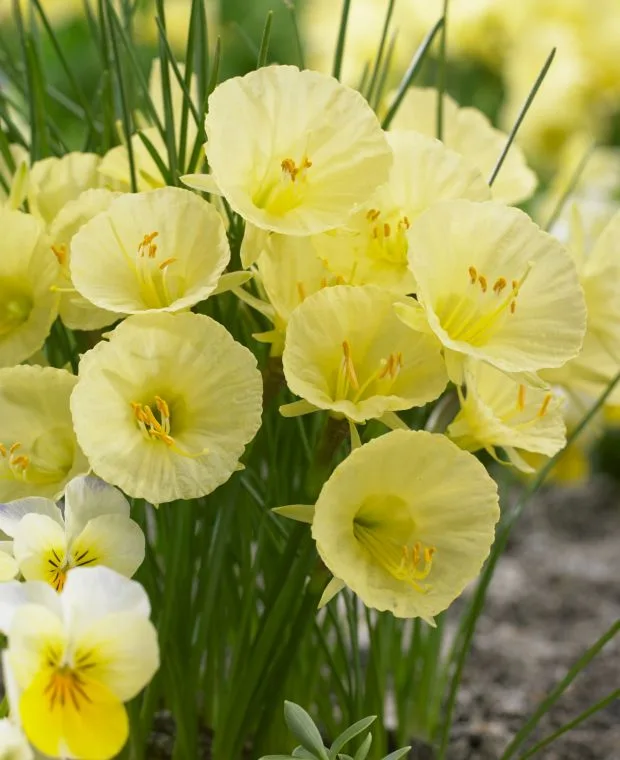
A small, bulbous perennial with dark green, tubular leaves. The scented, pale yellow flowers, produced between late autumn and early spring, have short, narrow petals and a very wide trumpet, up to 3cm across, with a rolled back rim and protruding stamens
Scientific classification
- Species
- daffodil 'Julia Jane' (Narcissus romieuxii 'Julia Jane')
- Genus
- Narcissus
- Family
- Amaryllidaceae
- Order
- Asparagales
- Class
- Liliopsida
- Phylum
- Magnoliophyta
- Harmful if eaten, skin irritant. Wear gloves and other protective equipment when handling]
- Toxicity
- Bulbs
- Plant type
- 0.1-0.5 metres
- Height
- 0-0.1 metre
- Spread
- Deciduous
- Foliage
- Clump forming · Tufted
- Habit
- Autumn · Spring · Winter
- Season of interest
- Full sun · Partial shade
- Sunlight
- Information to be completed
- Ideal temperature









daffodil 'Julia Jane' pictures
Distribution of daffodil 'Julia Jane'
Distribution map
- Native
- Introduced
- Cultivated
Source:WCVP v16 · Royal Botanic Gardens, Kew · CC BY 3.0 · Boundaries:WGSRPD / TDWG
Toxicity
Harmful if eaten, skin irritant. Wear gloves and other protective equipment when handling]
daffodil 'Julia Jane' care guide
- Moist soil during active growth, then reduce watering after foliage yellows
- Watering
- Full sun · Partial shade
- Sunlight

Watering
Moist soil during active growth, then reduce watering after foliage yellows
Fertilizing
 Fertilizing
Light bulb fertilizer at emergence and again after flowering
Pruning
 Pruning
Deadhead as flowers fade and allow foliage to die back naturally
Propagation
 Propagation
Propagate by seed sown as soon as ripe in a container in a cold frame, or by separating offsets in early autumn before the roots start to grow
Growing
 Growing
Grow in a cold greenhouse, bulb frame or alpine house in free-draining compost (e.g. 2 parts loam-based compost to 1 part grit). Allow to dry out completely during summer dormancy, repotting into damp compost in early autumn. See also daffodil cultivation
Common pests and diseases
Diseases
May be susceptible to narcissus basal rot, narcissus leaf scorch or daffodil viruses
Pests
May be susceptible to slugs, narcissus bulb fly, narcissus eelworm, and bulb scale mite
Explore the plant health library →




