
commonName:"lily of the valley 'Prolificans'"
Also known as: Information to be completed
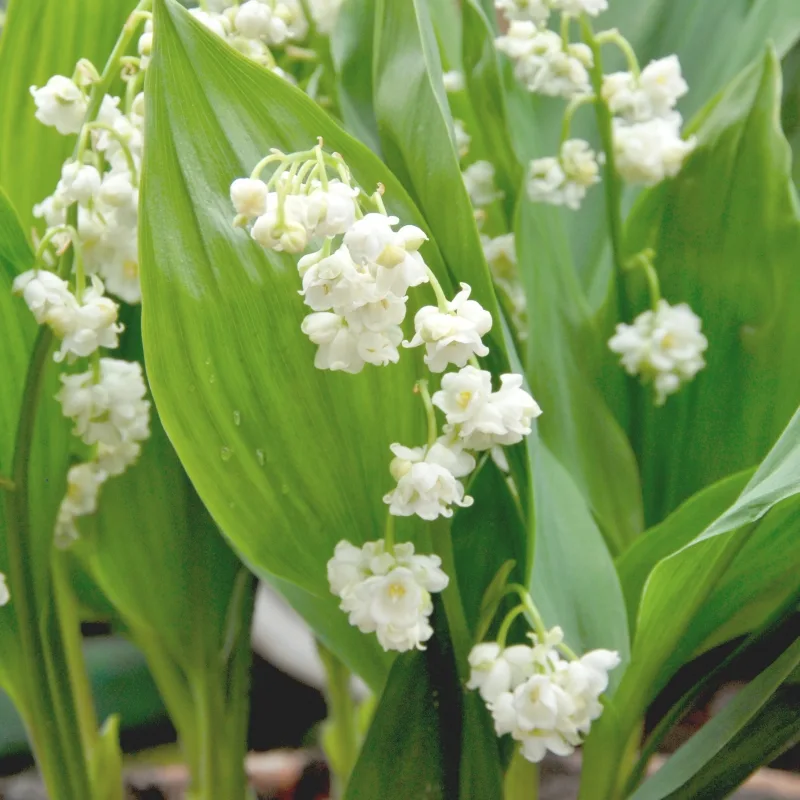
A spreading perennial to 25cm high, producing pairs of deep green, oval to elliptic basal leaves from creeping rhizomes. In late spring, produces tight clusters of pendent, fragrant, double white flowers on branching stems
Scientific classification
- Species
- commonName:"lily of the valley 'Prolificans'" (Convallaria majalis 'Prolificans')
- Genus
- Convallaria
- Family
- Asparagaceae
- Order
- Asparagales
- Class
- Liliopsida
- Phylum
- Tracheophyta
- TOXIC if eaten. Wear gloves and other protective equipment when handling
- Toxicity
- Herbaceous Perennial
- Plant type
- 0.1-0.5 metres
- Height
- 0.1-0.5 metres
- Spread
- Deciduous
- Foliage
- Matforming
- Habit
- Autumn · Spring · Summer
- Season of interest
- Full shade · Partial shade
- Sunlight
- Information to be completed
- Ideal temperature









commonName:"lily of the valley 'Prolificans'" pictures
Distribution of commonName:"lily of the valley 'Prolificans'"
Distribution map
- Native
- Introduced
- Cultivated
Source:WCVP v16 · Royal Botanic Gardens, Kew · CC BY 3.0 · Boundaries:WGSRPD / TDWG
Toxicity
TOXIC if eaten. Wear gloves and other protective equipment when handling
commonName:"lily of the valley 'Prolificans'" care guide
- Moderate regular watering, avoid prolonged drought or waterlogging
- Watering
- Full shade · Partial shade
- Sunlight

Watering
Moderate regular watering, avoid prolonged drought or waterlogging
Fertilizing
 Fertilizing
Balanced feed in spring and light repeat in growth season
Pruning
 Pruning
No pruning required
Propagation
 Propagation
Propagate by division in autumn
Growing
 Growing
Grow in a fertile, humus-rich moist soil in full or partial shade. Top dress with leaf mould in autumn
Common pests and diseases
Diseases
May be susceptible to grey moulds and leaf spots
Pests
May be susceptible to swift moth caterpillar
Explore the plant health library →




