
spurge 'Blue Hills'
Also known as: Information to be completed
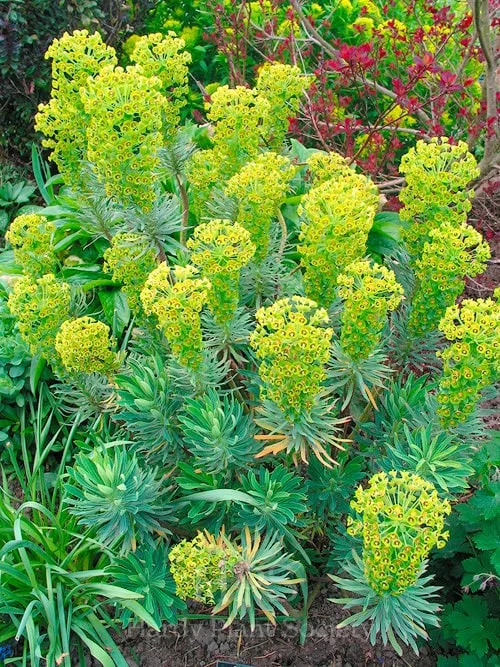
Blue Hills' is a compact, evergreen perennial or sub-shrub about 1m tall and wide, with tightly-packed blue-green leaves and yellow-green flowers with a dark red eye in spring and summer
Scientific classification
- Species
- spurge 'Blue Hills' (Euphorbia characias 'Blue Hills')
- Genus
- Euphorbia
- Family
- Euphorbiaceae
- Order
- Malpighiales
- Class
- Magnoliopsida
- Phylum
- Magnoliophyta
- IRRITANT to skin/eye, harmful if eaten. Wear gloves and other protective equipment when handling]
- Toxicity
- Herbaceous Perennial
- Plant type
- 0.5-1 metres
- Height
- 0.5-1 metres
- Spread
- Evergreen
- Foliage
- Information to be completed
- Habit
- Spring · Summer · Autumn · Winter
- Season of interest
- Full sun
- Sunlight
- Information to be completed
- Ideal temperature









spurge 'Blue Hills' pictures
Distribution of spurge 'Blue Hills'
Distribution map
- Native
- Introduced
- Cultivated
Source:WCVP v16 · Royal Botanic Gardens, Kew · CC BY 3.0 · Boundaries:WGSRPD / TDWG
Toxicity
IRRITANT to skin/eye, harmful if eaten. Wear gloves and other protective equipment when handling]
spurge 'Blue Hills' care guide
- Moderate regular watering, allowing brief slight drying between soakings
- Watering
- Full sun
- Sunlight

Watering
Moderate regular watering, allowing brief slight drying between soakings
Fertilizing
 Fertilizing
Balanced perennial feed every four weeks from spring through summer
Pruning
 Pruning
Cut back flowering shoots to ground level in late summer or autumn
Propagation
 Propagation
Propagate by division in early spring or take basal cuttings in spring or early summer; dip cut surfaces in charcoal or lukewarm water to prevent bleeding
Growing
 Growing
Grow in well-drained, light soil in full sun. See Euphorbia for further advice
Common pests and diseases
Diseases
May be susceptible to root and stem rots in wet conditions
Pests
May be susceptible to aphids
Explore the plant health library →




