
Pinus flexilis 'Vanderwolf's Pyramid'
Also known as: Information to be completed
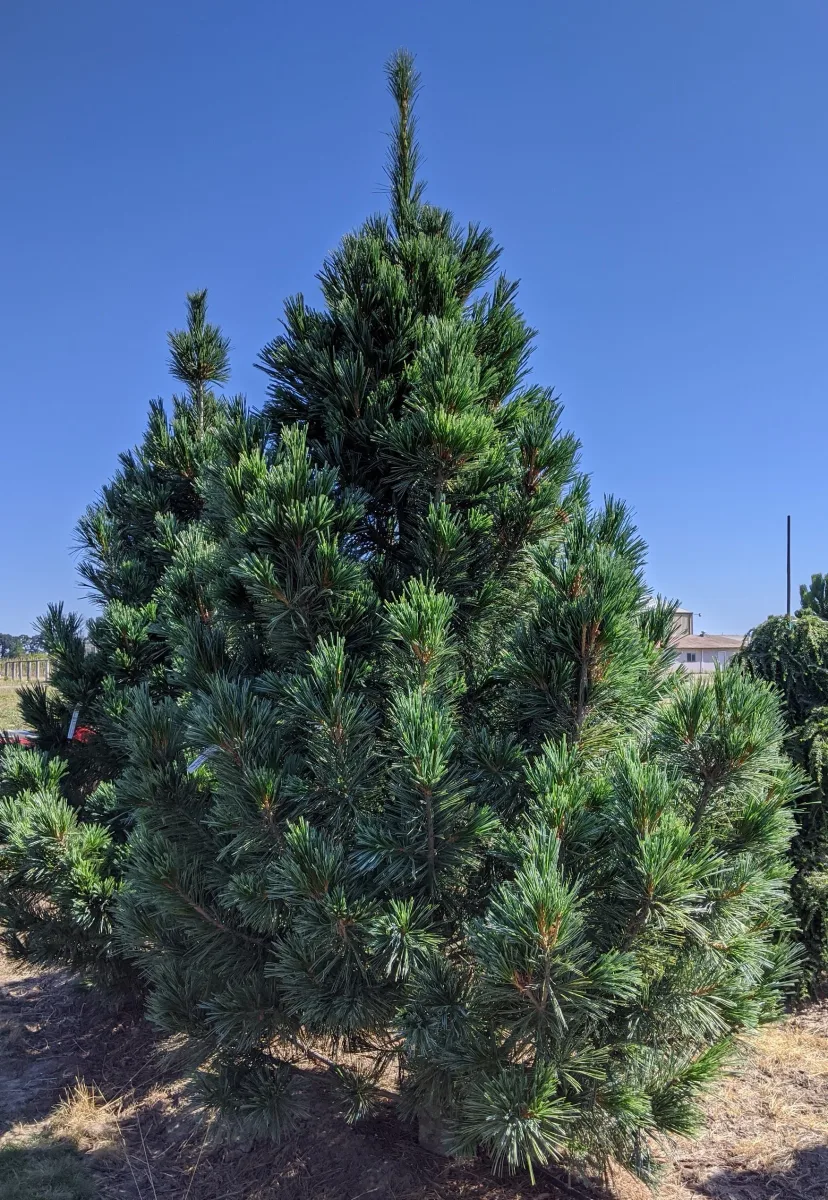
A medium-sized evergreen pine, forming an attractive, symmetrical, conical canopy to 6m (20ft) high and up to 3m (10ft) wide at the base. Twisted soft needles to 9cm (3½in) long are produced radially along the stems, emerging in bundles of five. These are silvery-blue beneath and dark-green on their upper surfaces and the twisting of the needles, provides an interesting two-tone effect. A useful subject as an architectural focus for a smaller city garden, or for a border where space is limited
Scientific classification
- Species
- Pinus flexilis 'Vanderwolf's Pyramid' (Pinus flexilis 'Vanderwolf's Pyramid')
- Genus
- Pinus
- Family
- Pinaceae
- Information to be completed
- Toxicity
- Trees · Conifers
- Plant type
- 4-8 metres
- Height
- 2.5-4 metres
- Spread
- Evergreen
- Foliage
- Columnar upright
- Habit
- Spring · Summer · Autumn · Winter
- Season of interest
- Full sun
- Sunlight
- Information to be completed
- Ideal temperature









Pinus flexilis 'Vanderwolf's Pyramid' pictures
Distribution of Pinus flexilis 'Vanderwolf's Pyramid'
Distribution map
- Native
- Introduced
- Cultivated
Source:WCVP v16 · Royal Botanic Gardens, Kew · CC BY 3.0 · Boundaries:WGSRPD / TDWG
Culture
Information to be completed
Toxicity
Information to be completed
Quick identification of Pinus flexilis 'Vanderwolf's Pyramid'
Information to be completed
Pinus flexilis 'Vanderwolf's Pyramid' care guide
- Infrequent deep watering, mature tree tolerates extended dryness
- Watering
- Full sun
- Sunlight
- Information to be completed
- Ideal temperature

Watering
Infrequent deep watering, mature tree tolerates extended dryness
Fertilizing
 Fertilizing
Slow-release conifer fertilizer applied once every early spring
Pruning
 Pruning
No pruning required
Propagation
 Propagation
Propagate by semi-ripe cuttings, by hardwood cuttings, or by grafting
Growing
 Growing
Grow in well-drained, preferably neutral to acidic soil in full sun
People also ask
Information to be completed
Common pests and diseases
Diseases
May be susceptible to honey fungus and needle cast diseases
Pests
May be susceptible to adelgids, conifer aphid, sawfly larvae, and pine shoot moth
Explore the plant health library →




