
Canary marguerite
Also known as: Information to be completed
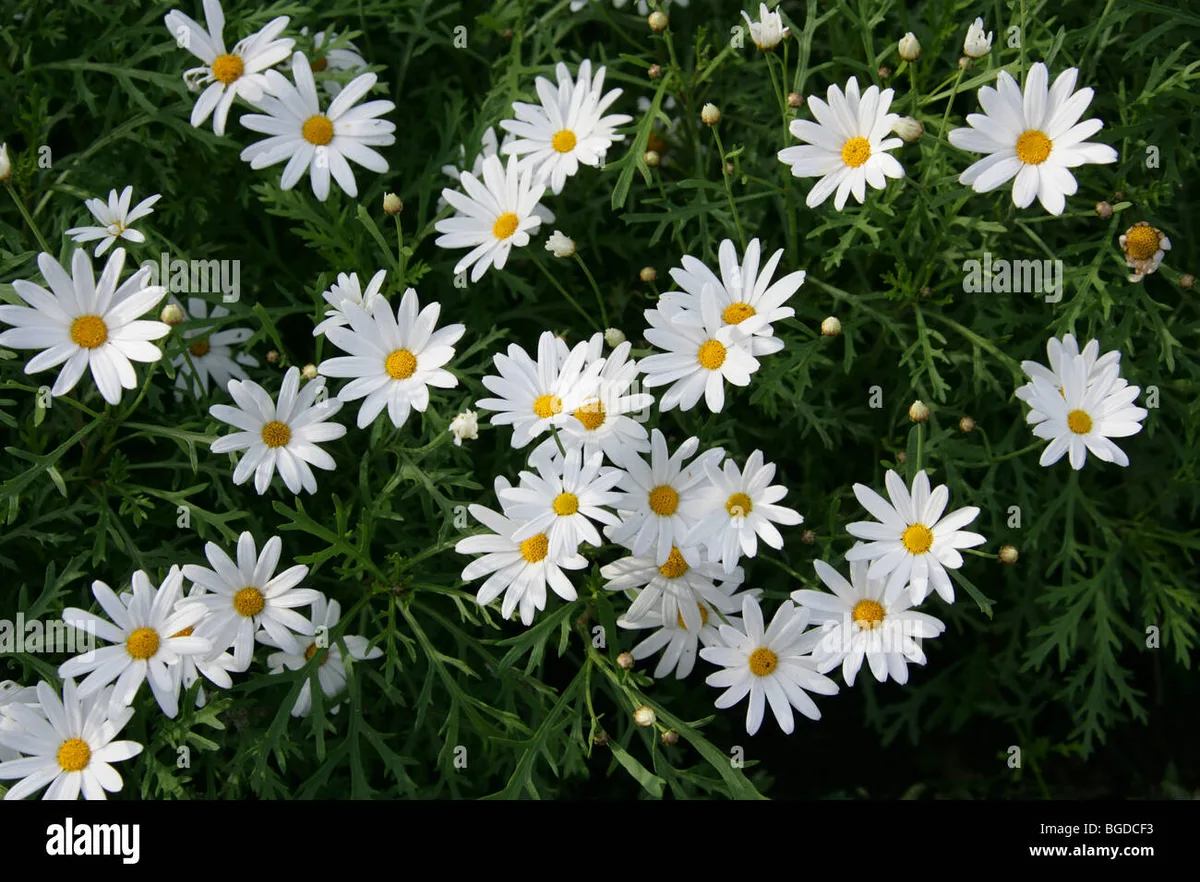
An evergreen subshrub to 60cm tall, with divided, dull grey-green foliage and large, yellow-centred, white daisies. Free-flowering over a long period
Scientific classification
- Species
- Canary marguerite (Argyranthemum frutescens subsp. canariae)
- Genus
- Argyranthemum
- Family
- Asteraceae
- Order
- Asterales
- Class
- Magnoliopsida
- Phylum
- Magnoliophyta
- Information to be completed
- Toxicity
- Bedding
- Plant type
- 0.5-1 metres
- Height
- 0.1-0.5 metres
- Spread
- Evergreen
- Foliage
- Bushy
- Habit
- Spring · Summer · Autumn · Winter
- Season of interest
- Full sun
- Sunlight
- Information to be completed
- Ideal temperature









Canary marguerite pictures
Distribution of Canary marguerite
Distribution map
- Native
- Introduced
- Cultivated
Source:WCVP v16 · Royal Botanic Gardens, Kew · CC BY 3.0 · Boundaries:WGSRPD / TDWG
Canary marguerite care guide
- Keep soil evenly moist with free drainage
- Watering
- Full sun
- Sunlight

Watering
Keep soil evenly moist with free drainage
Fertilizing
 Fertilizing
Light balanced feed during active growth season
Pruning
 Pruning
Shorten flowered shoots to about 1.5–2.5 cm from the previous year's growth. If flowering is on last year's growth, prune after flowering; if on current-year growth, prune the following early to mid-spring. Remove spent flowers regularly.
Propagation
 Propagation
Propagate by softwood cuttings in spring, and semi-hardwood cuttings of non-flowering shoots at other times
Growing
 Growing
Grow in moderately fertile, well-drained soil in full sun. Deadhead regularly to prolong flowering and pinch growing tips to keep compact. Best used as a summer bedding plant. Mulching helps to conserve water. Water in prolonged dry spells
Common pests and diseases
Diseases
Crown gall is an occasional problem
Pests
Leaf miners may be a problem
Explore the plant health library →




