
ash 'Autumn Purple'
Also known as: Information to be completed
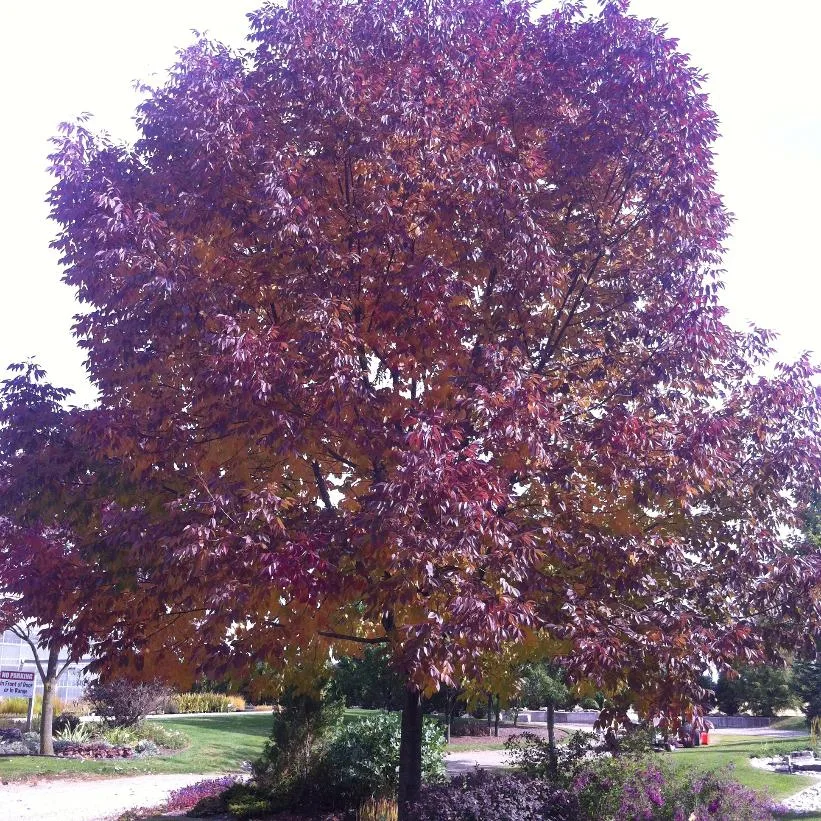
A spreading, broadly conical, deciduous tree to around 18m tall. Leaves are made up of seven, nine or rarely five, oval to oblong leaflets, dark green above and whitish-green below. Leaves turn vibrant shades of red, purple, orange and yellow in the autumn. Inconspicuous green flowers are borne in spring. The grey bark develops distinctive ridging on mature trees
Scientific classification
- Species
- ash 'Autumn Purple' (Fraxinus americana 'Autumn Purple')
- Genus
- Fraxinus
- Family
- Oleaceae
- Order
- Lamiales
- Class
- Magnoliopsida
- Phylum
- Tracheophyta
- Information to be completed
- Toxicity
- Trees
- Plant type
- Higher than 12 metres
- Height
- wider than 8 metres
- Spread
- Deciduous
- Foliage
- Information to be completed
- Habit
- Autumn · Spring · Summer
- Season of interest
- Full sun · Partial shade
- Sunlight
- Information to be completed
- Ideal temperature









ash 'Autumn Purple' pictures
Distribution of ash 'Autumn Purple'
Distribution map
- Native
- Introduced
- Cultivated
Source:WCVP v16 · Royal Botanic Gardens, Kew · CC BY 3.0 · Boundaries:WGSRPD / TDWG
ash 'Autumn Purple' care guide
- Light regular watering, keeping acidic soil mildly moist and airy
- Watering
- Full sun · Partial shade
- Sunlight

Watering
Light regular watering, keeping acidic soil mildly moist and airy
Fertilizing
 Fertilizing
Light heather feed every four weeks through mild growing weather
Pruning
 Pruning
Little pruning is needed. Remove diseased, damaged, crowded or crossing shoots and unwanted growth. Timing depends on the plant: generally late winter or early spring; plants prone to bleeding and deciduous magnolias need different timing, and deciduous azaleas and lilacs are pruned after flowering.
Propagation
 Propagation
Propagate by grafting
Growing
 Growing
Grow in any well drained soil in full sun or partial shade
Common pests and diseases
Diseases
Ash dieback has recently been found in the UK. Restrictions have been put in place (from 29 October 2012) regarding both the importation of ash from abroad and the movement of ash within the UK. May also be susceptible to honey fungus
Pests
Generally pest-free
Explore the plant health library →




