
fern asparagus 'Pyramidalis'
Also known as: Information to be completed
A tender evergreen perennial with a bushy pyramidal upright habit found in woodland edge settings where it can become invasive, also used as a house plant, in container displays and floristry for its decorative foliage. The thorny stems have bristle needle-like leaves that form triangular upright plumes, 16 to 24 inches long, with a dense fern-like feathery quality. It has air-purifying attributes. Although best known for its feathery attractive foliage, it has also small, insignificant, off-white flowers in Spring.
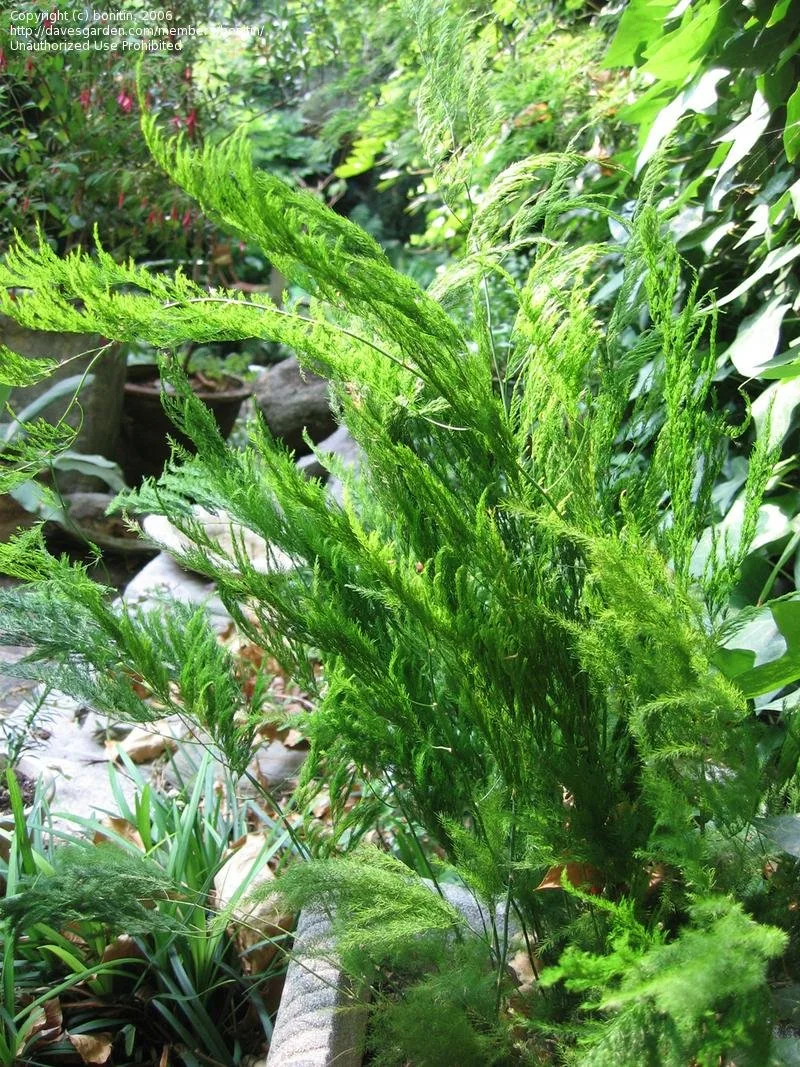
Scientific classification
- Species
- fern asparagus 'Pyramidalis' (Asparagus setaceus 'Pyramidalis')
- Genus
- Asparagus
- Family
- Asparagaceae
- Skin allergen, fruits harmful if eaten. Wear gloves and other protective equipment when handling]
- Toxicity
- Houseplants
- Plant type
- 1-1.5 metres
- Height
- 0.5-1 metres
- Spread
- Evergreen
- Foliage
- Bushy · Climbing · Columnar upright
- Habit
- Spring · Summer · Autumn · Winter
- Season of interest
- Full shade · Partial shade
- Sunlight
- Information to be completed
- Ideal temperature









fern asparagus 'Pyramidalis' pictures
Distribution of fern asparagus 'Pyramidalis'
Distribution map
Information to be completed
Information to be completed
Culture
Information to be completed
Toxicity
Skin allergen, fruits harmful if eaten. Wear gloves and other protective equipment when handling]
Quick identification of fern asparagus 'Pyramidalis'
Information to be completed
fern asparagus 'Pyramidalis' care guide
- Light frequent misting and watering, avoid fully drying root mass
- Watering
- Full shade · Partial shade
- Sunlight
- Information to be completed
- Ideal temperature

Watering
Light frequent misting and watering, avoid fully drying root mass
Fertilizing
 Fertilizing
Very weak foliage liquid feed every four spring and summer weeks
Pruning
 Pruning
Pinch back the tips of stems to keep the shape and to promote density in the foliage. It can be cut back to the ground to regenerate.
Propagation
 Propagation
Propagate by division and by seed.
Growing
 Growing
As a house plant, it prefers a fertile moisture retentive medium and to be placed away from direct sunlight. Keep away from the sun to achieve a darker shade of green in the foliage. Cut back to soil level if there is a need to regenerate the plant and regularly pinch back to make the plant bushier. Keep soil moist but not waterlogged.
People also ask
Information to be completed
Common pests and diseases
Diseases
May be susceptible to foot and root rot
Pests
May be susceptible to asparagus beetle, slugs and snails
Explore the plant health library →




