
Alstroemeria 'Diana'
Also known as: Information to be completed
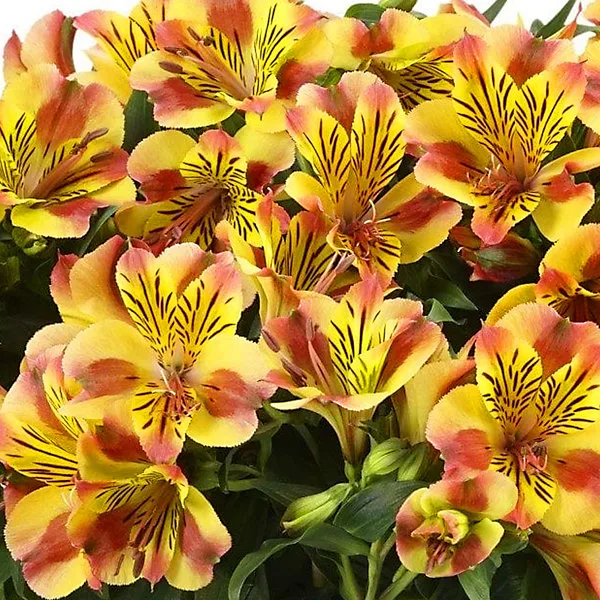
Compact, clump-forming perennial to about 40cm tall, with mid-green lance-shaped leaves, and clusters of long-lasting, funnel-shaped flowers in shades of orange and rose-pink with yellow inner petals that are strongly flecked purple-brown, in summer and autumn
Scientific classification
- Species
- Alstroemeria 'Diana' (Alstroemeria 'Diana')
- Genus
- Alstroemeria
- Family
- Alstroemeriaceae
- Order
- Liliales
- Class
- Liliopsida
- Phylum
- Magnoliophyta
- Skin allergen. Wear gloves and other protective equipment when handling
- Toxicity
- Herbaceous Perennial
- Plant type
- 0.1-0.5 metres
- Height
- 0.1-0.5 metres
- Spread
- Deciduous
- Foliage
- Clump forming
- Habit
- Spring · Summer · Autumn
- Season of interest
- Full sun · Partial shade
- Sunlight
- Information to be completed
- Ideal temperature









Alstroemeria 'Diana' pictures
Toxicity
Skin allergen. Wear gloves and other protective equipment when handling
Alstroemeria 'Diana' care guide
- Keep soil consistently lightly moist, avoid both drought and waterlogging
- Watering
- Full sun · Partial shade
- Sunlight

Watering
Keep soil consistently lightly moist, avoid both drought and waterlogging
Fertilizing
 Fertilizing
Diluted balanced plant food every two weeks spring until autumn frost
Pruning
 Pruning
Pull up spent flowered stems, leaving tubers in ground
Propagation
 Propagation
Propagate by division in autumn or very early spring
Growing
 Growing
Grow in fertile, moist but well-drained soils in full sun or partial shade. Young plants are best left undisturbed to form clumps; use a dry mulch for the first two winters. See Alstroemeria cultivation
Common pests and diseases
Diseases
Generally disease-free but may be susceptible to a virus
Pests
May be susceptible to slugs
Explore the plant health library →




