
bleeding heart 'Snowdrift'
Also known as: Information to be completed
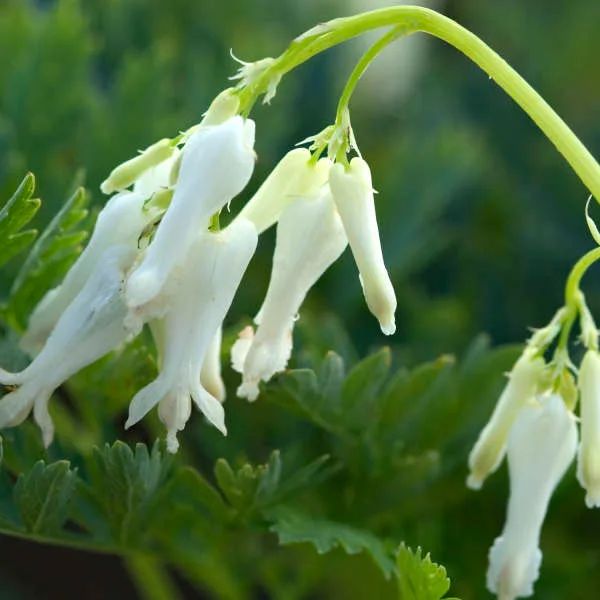
A clump-forming, tuberous perennial to 30cm tall, producing pale grey-green, parsley-like leaves, and sprays of pure white flowers to 3cm long, during mid-spring and sparingly through to early autumn
Scientific classification
- Species
- bleeding heart 'Snowdrift' (Dicentra eximia 'Snowdrift')
- Genus
- Dicentra
- Family
- Papaveraceae
- Order
- Ranunculales
- Class
- Magnoliopsida
- Phylum
- Magnoliophyta
- Information to be completed
- Toxicity
- Herbaceous Perennial
- Plant type
- Information to be completed
- Height
- Information to be completed
- Spread
- Deciduous
- Foliage
- Clump forming
- Habit
- Spring · Summer · Autumn
- Season of interest
- Partial shade
- Sunlight
- Information to be completed
- Ideal temperature









bleeding heart 'Snowdrift' pictures
Distribution of bleeding heart 'Snowdrift'
Distribution map
- Native
- Introduced
- Cultivated
Source:WCVP v16 · Royal Botanic Gardens, Kew · CC BY 3.0 · Boundaries:WGSRPD / TDWG
bleeding heart 'Snowdrift' care guide
- Keep rich woodland soil evenly moist, never baking dry in summer
- Watering
- Partial shade
- Sunlight

Watering
Keep rich woodland soil evenly moist, never baking dry in summer
Fertilizing
 Fertilizing
Light balanced feed monthly during spring and early summer growth
Pruning
 Pruning
No pruning required
Propagation
 Propagation
Propagate by division in early spring or after the leaves have died down
Growing
 Growing
Plant in moist, fertile, humus-rich soil. Best in neutral or slightly alkaline soil, in part shade in a sheltered position
Common pests and diseases
Diseases
Generally disease-free
Pests
May be suscceptible to slugs and snails damaging emerging foliage
Explore the plant health library →




