
white cedar 'Golden Globe'
Also known as: Information to be completed
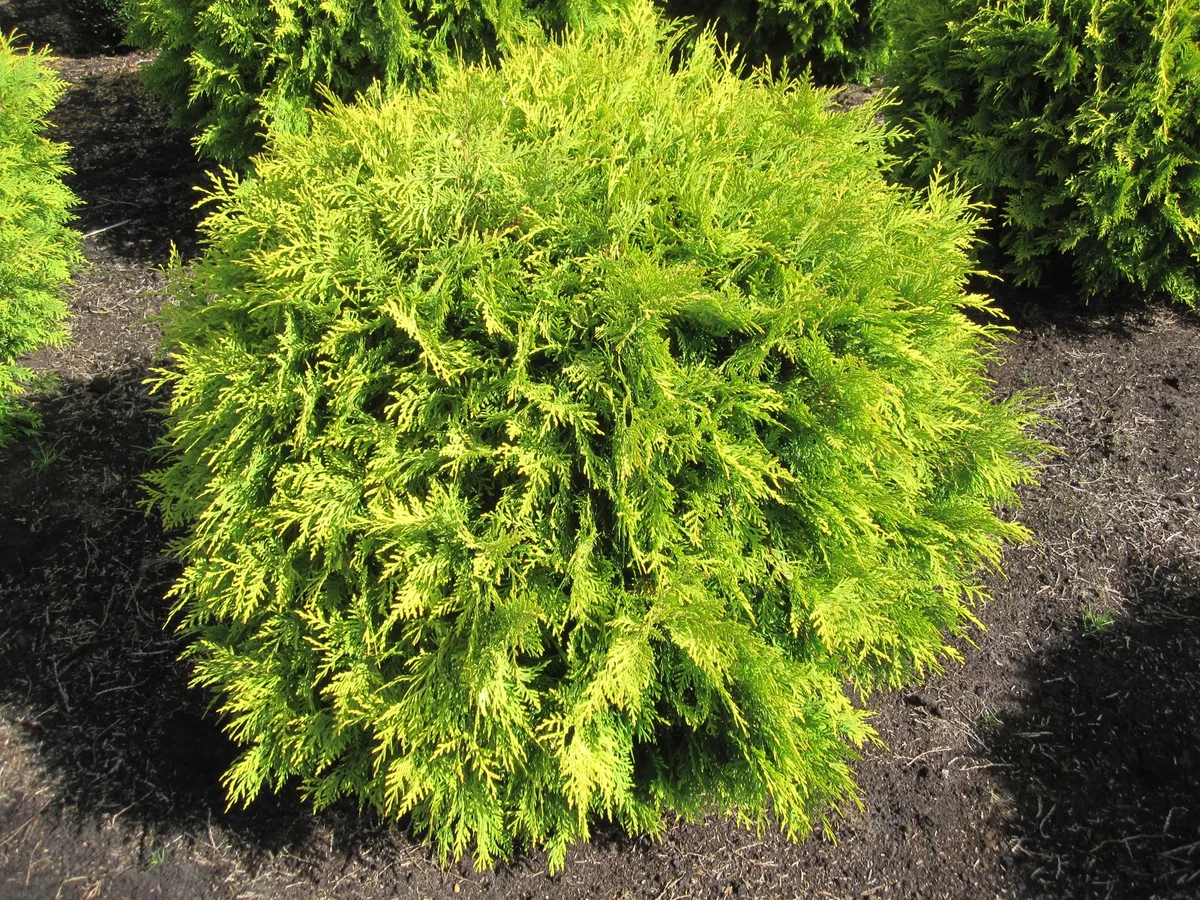
A dwarf, evergreen coniferous shrub, slowly growing into a rounded globular shape with a maximum height of 1.5m (5ft) and as much across. Producing dense flat sparays of yellow green foliage. Its strictly conical form is useful as an architectural focal point in a garden, as well as being a good addition to city and courtyard gardens, where ultimate size is an important consideration. Unlike many other golden leaved forms, this cultivar is able to tolerate direct summer sun without its foliage becoming scorched
Scientific classification
- Species
- white cedar 'Golden Globe' (Thuja occidentalis 'Golden Globe')
- Genus
- Thuja
- Family
- Cupressaceae
- Order
- Cupressales
- Class
- Pinopsida
- Phylum
- Pinophyta
- Harmful if eaten, skin allergen. Wear gloves and other protective equipment when handling]
- Toxicity
- Shrubs
- Plant type
- 1-1.5 metres
- Height
- 1-1.5 metres
- Spread
- Evergreen
- Foliage
- Bushy
- Habit
- Spring · Summer · Autumn · Winter
- Season of interest
- Full sun
- Sunlight
- Information to be completed
- Ideal temperature









white cedar 'Golden Globe' pictures
Distribution of white cedar 'Golden Globe'
Distribution map
- Native
- Introduced
- Cultivated
Source:WCVP v16 · Royal Botanic Gardens, Kew · CC BY 3.0 · Boundaries:WGSRPD / TDWG
Toxicity
Harmful if eaten, skin allergen. Wear gloves and other protective equipment when handling]
white cedar 'Golden Globe' care guide
- Deep occasional watering with excellent drainage, less once established
- Watering
- Full sun
- Sunlight

Watering
Deep occasional watering with excellent drainage, less once established
Fertilizing
 Fertilizing
Light conifer feed once yearly in early spring only
Pruning
 Pruning
No pruning required
Propagation
 Propagation
Propagate by semi-hardwood cuttings
Growing
 Growing
Grows well in any moist, but well-drained soil in full sun
Common pests and diseases
Diseases
May be susceptible to honey fungus and other fungal diseases, particularly thuja blight and Coryneum canker (see conifers: brown patches)
Pests
May be susceptible to scale insects and conifer aphids
Explore the plant health library →




