
false acacia 'Lace Lady'
Also known as: Information to be completed
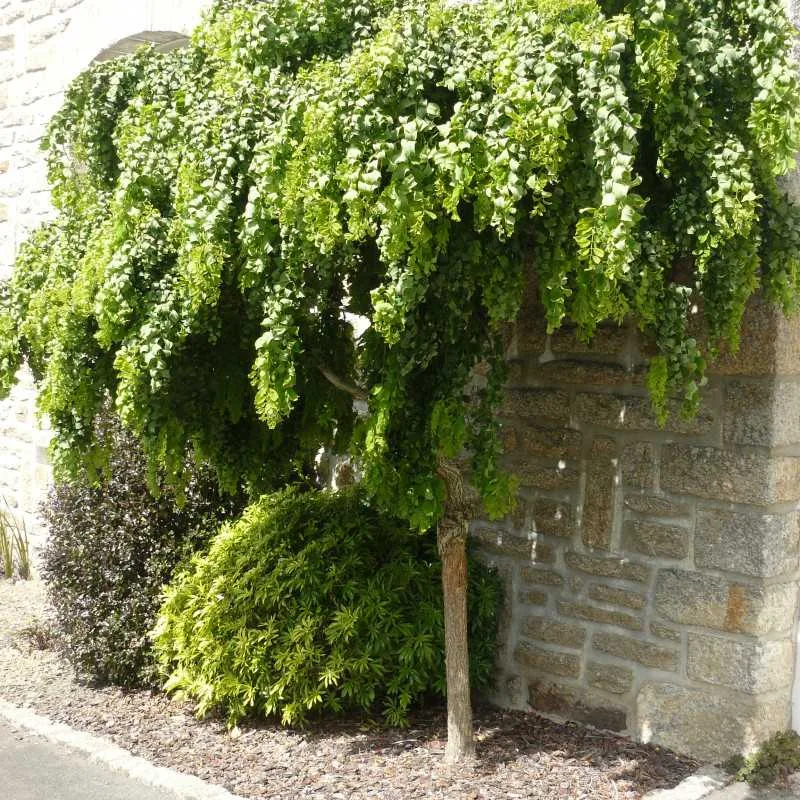
A slow-growing deciduous tree with twisted stems and curly leaves, reaching about 3m. The leaves are green with many pairs of rounded leaflets, turning yellow in autumn.
Scientific classification
- Species
- false acacia 'Lace Lady' (Robinia pseudoacacia 'Lace Lady')
- Genus
- Robinia
- Family
- Fabaceae
- Order
- Fabales
- Class
- Magnoliopsida
- Phylum
- Magnoliophyta
- Harmful if eaten, skin irritant. Wear gloves and other protective equipment when handling]
- Toxicity
- Trees
- Plant type
- 2.5-4 metres
- Height
- 2.5-4 metres
- Spread
- Deciduous
- Foliage
- Columnar upright · Suckering
- Habit
- Autumn · Spring · Summer
- Season of interest
- Full sun · Partial shade
- Sunlight
- Information to be completed
- Ideal temperature









false acacia 'Lace Lady' pictures
Distribution of false acacia 'Lace Lady'
Distribution map
- Native
- Introduced
- Cultivated
Source:WCVP v16 · Royal Botanic Gardens, Kew · CC BY 3.0 · Boundaries:WGSRPD / TDWG
Toxicity
Harmful if eaten, skin irritant. Wear gloves and other protective equipment when handling]
false acacia 'Lace Lady' care guide
- Water moderately, allow the soil to dry out between waterings, drought-tolerant.
- Watering
- Full sun · Partial shade
- Sunlight

Watering
Water moderately, allow the soil to dry out between waterings, drought-tolerant.
Fertilizing
 Fertilizing
Apply a balanced fertilizer once in early spring only.
Pruning
 Pruning
Little pruning is needed. Remove diseased, damaged, crowded or crossing shoots and unwanted growth. Timing depends on the plant: generally late winter or early spring; plants prone to bleeding and deciduous magnolias need different timing, and deciduous azaleas and lilacs are pruned after flowering.
Propagation
 Propagation
Propagate by hardwood cuttings or grafting
Growing
 Growing
Grow in any soil in good light. Remove any suckers that grow, which may have long thorns. For more advice see tree cultivation. Has the potential to become a nuisance if not managed well
Common pests and diseases
Diseases
May be susceptible to honey fungus
Pests
Generally pest-free
Explore the plant health library →




