
Bergenia crassifolia 'Autumn Red'
Also known as: Information to be completed
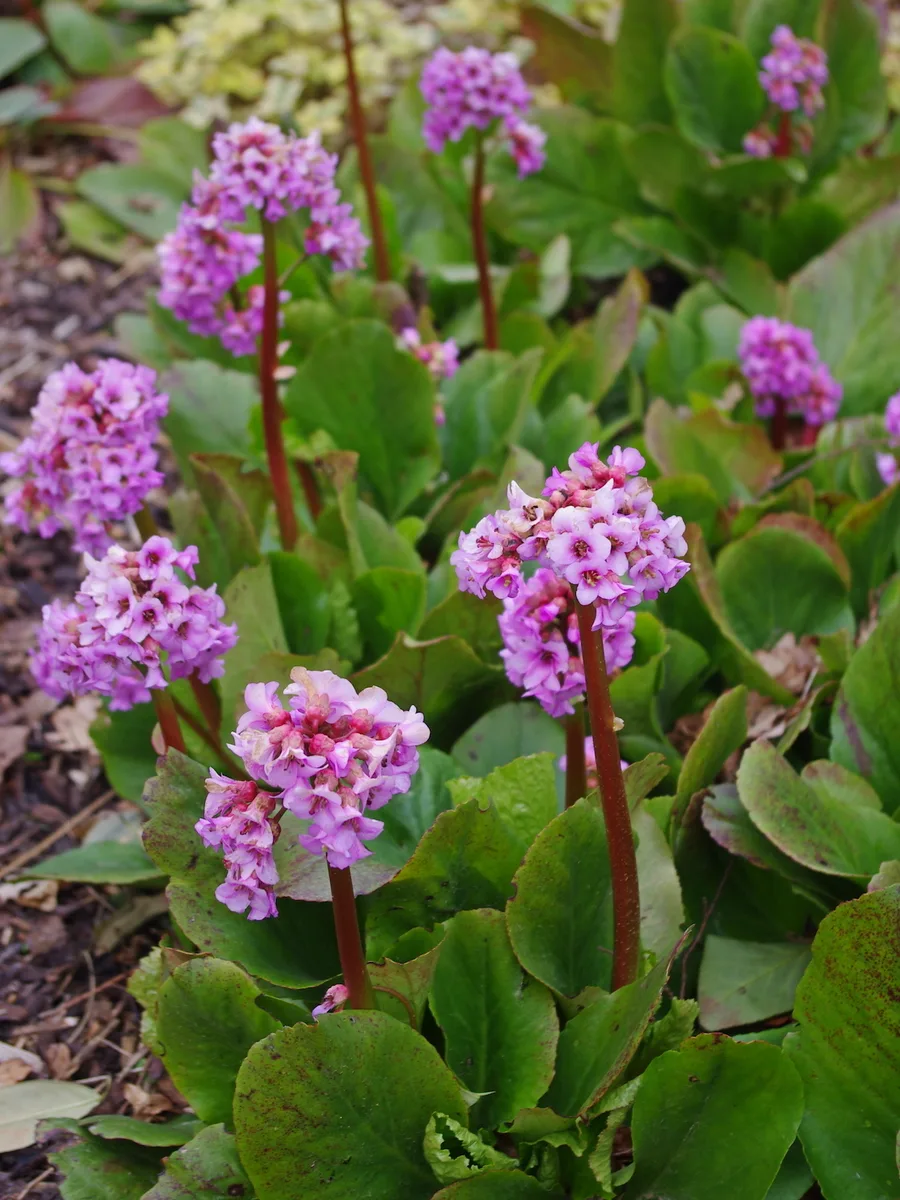
Has rounded, evergreen leaves that turn vivid red in autumn and winter; branched flower stems bearing soft pinkish-purple flowers appear in spring
Scientific classification
- Species
- Bergenia crassifolia 'Autumn Red' (Bergenia crassifolia 'Autumn Red')
- Genus
- Bergenia
- Family
- Saxifragaceae
- Order
- Saxifragales
- Class
- Magnoliopsida
- Phylum
- Magnoliophyta
- Information to be completed
- Toxicity
- Herbaceous Perennial
- Plant type
- 0.1-0.5 metres
- Height
- 0.1-0.5 metres
- Spread
- Evergreen
- Foliage
- Clump forming
- Habit
- Autumn · Winter · Spring · Summer
- Season of interest
- Full sun · Partial shade
- Sunlight
- Information to be completed
- Ideal temperature









Bergenia crassifolia 'Autumn Red' pictures
Distribution of Bergenia crassifolia 'Autumn Red'
Distribution map
- Native
- Introduced
- Cultivated
Source:WCVP v16 · Royal Botanic Gardens, Kew · CC BY 3.0 · Boundaries:WGSRPD / TDWG
Bergenia crassifolia 'Autumn Red' care guide
- Moderate regular watering, avoid prolonged drought and stagnant waterlogging
- Watering
- Full sun · Partial shade
- Sunlight

Watering
Moderate regular watering, avoid prolonged drought and stagnant waterlogging
Fertilizing
 Fertilizing
Balanced perennial feed every four weeks spring through summer growth
Pruning
 Pruning
Remove faded flower spikes and dying leaves in spring
Propagation
 Propagation
Divide established clumps or cut off rhizome sections with rosettes of leaves attached in spring
Growing
 Growing
Grows well in most humus-rich soils but dislikes extremes of heat and drought. Frosts may damage early flowers. See Bergenia cultivation for further advice
Common pests and diseases
Diseases
May be susceptible to a leaf spot
Pests
May be susceptible to vine weevils, slugs and snails, leaf and bud eelworm and some caterpillars
Explore the plant health library →




