
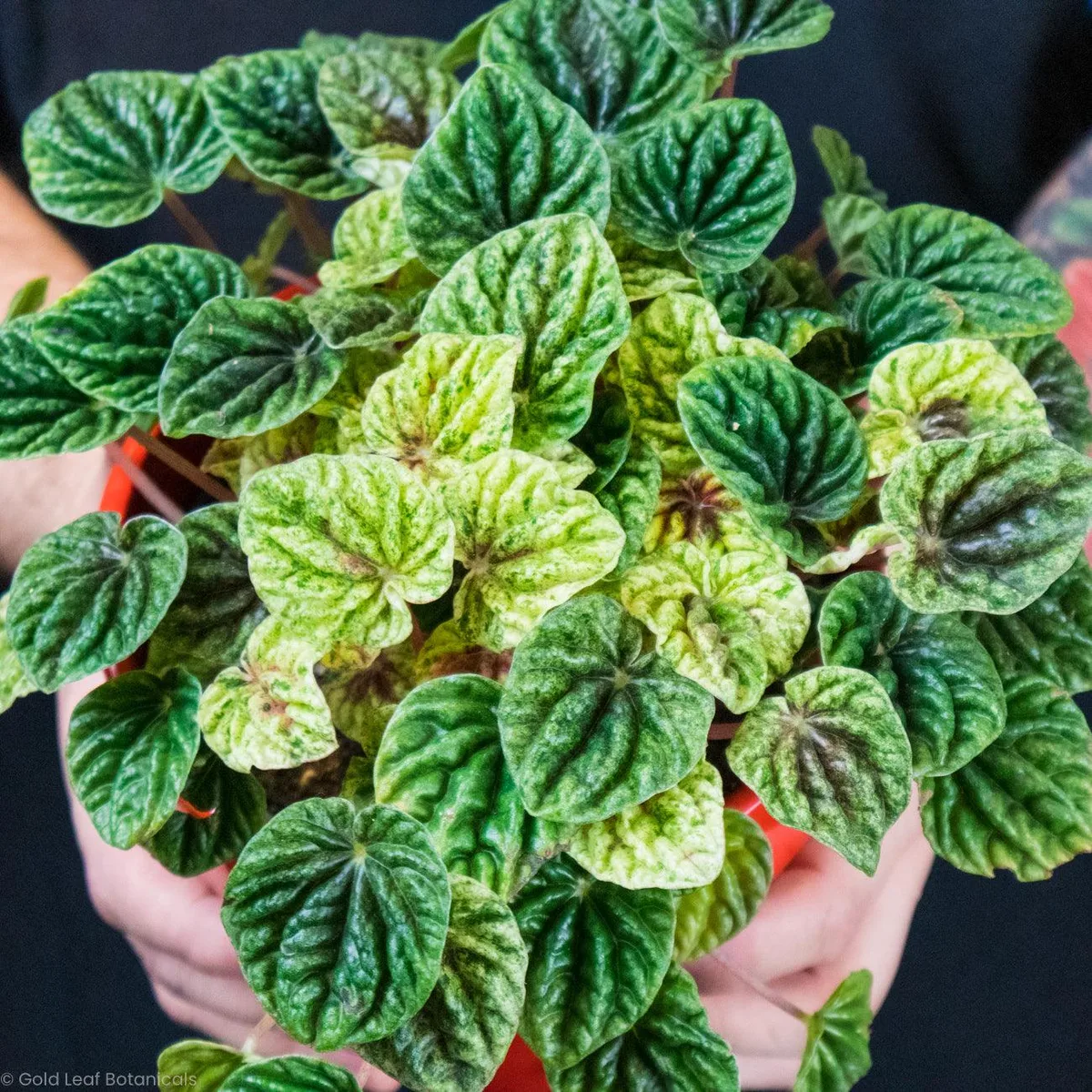
variegated green ripple plant
Also known as: Information to be completed
An evergreen mound-forming perennial to 15cm tall, with thick, puckered, heart-shaped, dark green leaves with white mottling; these are held on long, succulent stalks. From spring to autumn it produces upright, tail-like or club-shaped spikes of tiny greenish-white flowers
Scientific classification
- Species
- variegated green ripple plant (Peperomia caperata 'Variegata')
- Genus
- Peperomia
- Family
- Piperaceae
- Order
- Piperales
- Class
- Magnoliopsida
- Phylum
- Magnoliophyta
- Information to be completed
- Toxicity
- Houseplants
- Plant type
- 0.1-0.5 metres
- Height
- 0.1-0.5 metres
- Spread
- Evergreen
- Foliage
- Tufted
- Habit
- Spring · Summer · Autumn · Winter
- Season of interest
- Full sun · Partial shade
- Sunlight
- Information to be completed
- Ideal temperature









variegated green ripple plant pictures
Distribution of variegated green ripple plant
Distribution map
- Native
- Introduced
- Cultivated
Source:WCVP v16 · Royal Botanic Gardens, Kew · CC BY 3.0 · Boundaries:WGSRPD / TDWG
variegated green ripple plant care guide
- Moderate regular watering, allowing brief slight drying between soakings
- Watering
- Full sun · Partial shade
- Sunlight

Watering
Moderate regular watering, allowing brief slight drying between soakings
Fertilizing
 Fertilizing
Balanced perennial feed every four weeks from spring through summer
Pruning
 Pruning
No pruning required
Propagation
 Propagation
Propagate by sowing seed at 19-24°C when ripe; take leaf stalk or leaf blade cuttings in spring and summer
Growing
 Growing
Grow in houseplant compost in bright indirect light while in growth, moving into full light in winter. Water moderately in summer, sparingly in winter, preferably with tepid, soft water. From spring to summer mist daily to maintain moderate to high humidity; apply a balanced liquid fertiliser monthly. Pull off spent flowers. See houseplant cultivation for further information
Common pests and diseases
Diseases
May be susceptible to grey moulds
Pests
Generally pest-free
Explore the plant health library →




