
Rheum palmatum var. tanguticum
Also known as: Information to be completed
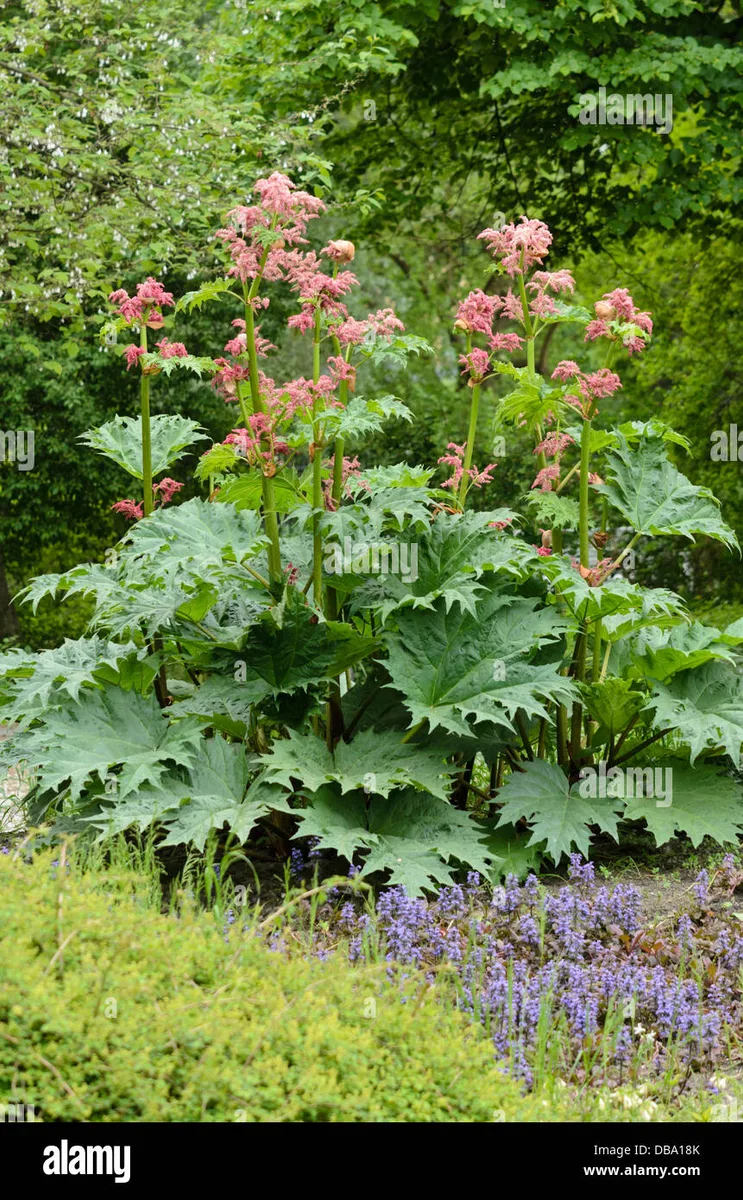
A rhizomatous perennial to 2m high, with large basal leaves that emerge from the ground in late spring. Leaves are jagged and deeply cut, and dark reddish-purple when young, maturing to deep green with red undersides and long, thick reddish stems. In summer, tall, branching flower stems bear upright clusters of tiny, densely packed flowers in shades of white, pink or deep red
Scientific classification
- Species
- Rheum palmatum var. tanguticum (Rheum palmatum var. tanguticum)
- Genus
- Rheum
- Family
- Polygonaceae
- Order
- Caryophyllales
- Class
- Magnoliopsida
- Phylum
- Magnoliophyta
- Harmful if eaten. Wear gloves and other protective equipment when handling LJD
- Toxicity
- Herbaceous Perennial
- Plant type
- 1.5-2.5 metres
- Height
- 1.5-2.5 metres
- Spread
- Deciduous
- Foliage
- Clump forming
- Habit
- Spring · Summer · Autumn
- Season of interest
- Full sun · Partial shade
- Sunlight
- Information to be completed
- Ideal temperature









Rheum palmatum var. tanguticum pictures
Distribution of Rheum palmatum var. tanguticum
Distribution map
- Native
- Introduced
- Cultivated
Source:WCVP v16 · Royal Botanic Gardens, Kew · CC BY 3.0 · Boundaries:WGSRPD / TDWG
Toxicity
Harmful if eaten. Wear gloves and other protective equipment when handling LJD
Rheum palmatum var. tanguticum care guide
- Water regularly, keeping the soil consistently moist but not waterlogged.
- Watering
- Full sun · Partial shade
- Sunlight

Watering
Water regularly, keeping the soil consistently moist but not waterlogged.
Fertilizing
 Fertilizing
Apply a balanced fertilizer monthly during the growing season.
Pruning
 Pruning
Deadhead spent flower spikes, cut back faded leaves at the end of the season
Propagation
 Propagation
Propagate by division in early spring
Growing
 Growing
Grow in deep, moist, fertile soil, ideally in a sunny position. Mulch with organic matter in early spring. While slightly smaller than the species, this variety still needs plenty of space
Common pests and diseases
Diseases
May be susceptible to crown rot, honey fungus and virus diseases
Pests
May be susceptible to slugs and blackfly (black aphid)
Explore the plant health library →




