
iris 'Black Knight'
Also known as: Information to be completed
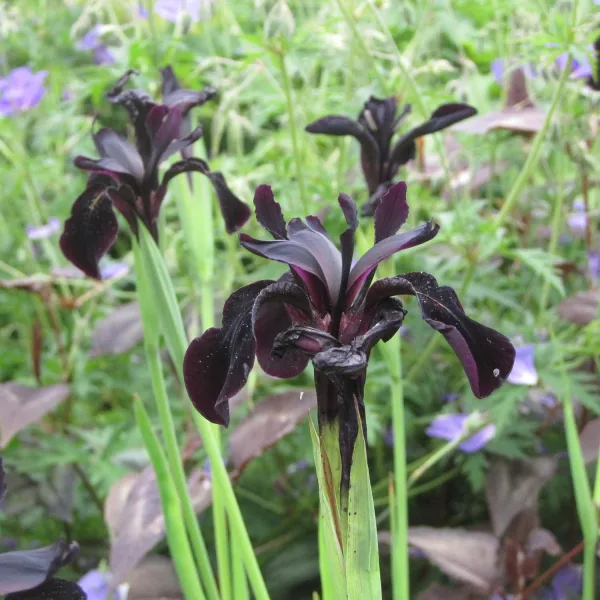
A highly attractive, clump forming, rhizomatous perennial with upright, strap-like, green leaves and erect stems in summer bearing dark-purple-black flowers with a golden-yellow streak on the lower petals, known as falls
Scientific classification
- Species
- iris 'Black Knight' (Iris chrysographes 'Black Knight')
- Genus
- Iris
- Family
- Iridaceae
- Order
- Asparagales
- Class
- Liliopsida
- Phylum
- Magnoliophyta
- Harmful if eaten. Wear gloves and other protective equipment when handling
- Toxicity
- Herbaceous Perennial
- Plant type
- 0.1-0.5 metres
- Height
- 0.1-0.5 metres
- Spread
- Deciduous
- Foliage
- Clump forming · Columnar upright
- Habit
- Spring · Summer · Autumn
- Season of interest
- Full sun · Partial shade
- Sunlight
- Information to be completed
- Ideal temperature









iris 'Black Knight' pictures
Distribution of iris 'Black Knight'
Distribution map
- Native
- Introduced
- Cultivated
Source:WCVP v16 · Royal Botanic Gardens, Kew · CC BY 3.0 · Boundaries:WGSRPD / TDWG
Toxicity
Harmful if eaten. Wear gloves and other protective equipment when handling
iris 'Black Knight' care guide
- Medium moisture growing period, drier soil once flowering cycle fully finishes
- Watering
- Full sun · Partial shade
- Sunlight

Watering
Medium moisture growing period, drier soil once flowering cycle fully finishes
Fertilizing
 Fertilizing
Diluted iris bulb feed every three to four weeks spring blooming season
Pruning
 Pruning
Cut back old flower stems after flowering and remove dying foliage in autumn
Propagation
 Propagation
Propagate by division of the rhizome shortly from mid-summer to early autumn. See dividing irises
Growing
 Growing
Grow in well-drained, neutral to slightly acid loam in full sun or partial shade. Mulch in spring
Common pests and diseases
Diseases
May be susceptible to aphid-borne viruses, bacterial soft rot and grey moulds; see Iris diseases
Pests
May be susceptible to slugs and snails
Explore the plant health library →




