
commonName:"dog's tooth violet 'Lilac Wonder'"
Also known as: Information to be completed
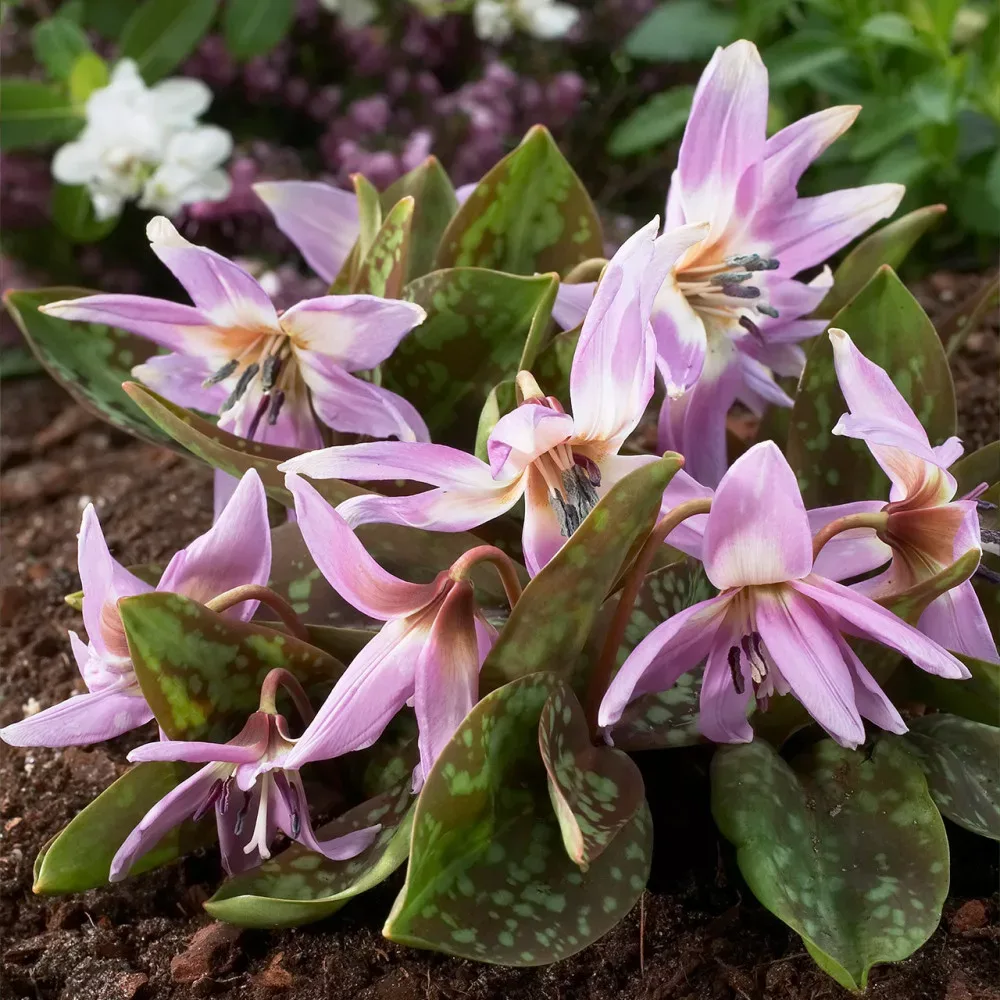
A bulbous perennial to 20cm high, with paired, broadly oval leaves, heavily mottled with brown. In spring, upright stems hold nodding, lilac-pink flowers, with deep brown spots at the base of each recurved petal, and prominent white stamens with purple anthers
Scientific classification
- Species
- commonName:"dog's tooth violet 'Lilac Wonder'" (Erythronium dens-canis 'Lilac Wonder')
- Genus
- Erythronium
- Family
- Liliaceae
- Order
- Liliales
- Class
- Liliopsida
- Phylum
- Magnoliophyta
- Ornamental bulbs - not to be eaten. Wear gloves and other protective equipment when handling
- Toxicity
- Bulbs
- Plant type
- 0.1-0.5 metres
- Height
- 0-0.1 metre
- Spread
- Deciduous
- Foliage
- Clump forming
- Habit
- Spring · Summer
- Season of interest
- Partial shade
- Sunlight
- Information to be completed
- Ideal temperature









commonName:"dog's tooth violet 'Lilac Wonder'" pictures
Distribution of commonName:"dog's tooth violet 'Lilac Wonder'"
Distribution map
- Native
- Introduced
- Cultivated
Source:WCVP v16 · Royal Botanic Gardens, Kew · CC BY 3.0 · Boundaries:WGSRPD / TDWG
Toxicity
Ornamental bulbs - not to be eaten. Wear gloves and other protective equipment when handling
commonName:"dog's tooth violet 'Lilac Wonder'" care guide
- Moderate regular watering, allowing brief slight drying between soakings
- Watering
- Partial shade
- Sunlight

Watering
Moderate regular watering, allowing brief slight drying between soakings
Fertilizing
 Fertilizing
Balanced perennial feed every four weeks from spring through summer
Pruning
 Pruning
No pruning required
Propagation
 Propagation
Propagate by division after flowering
Growing
 Growing
Plant 10cm deep in fertile, humus-rich, well-drained soil that does not dry out, in partial shade. Bulbs in storage must be kept slightly damp. See bulb cultivation
Common pests and diseases
Diseases
Generally disease-free
Pests
May be susceptible to slugs
Explore the plant health library →




