
lobster claw 'Roseus'
Also known as: Information to be completed
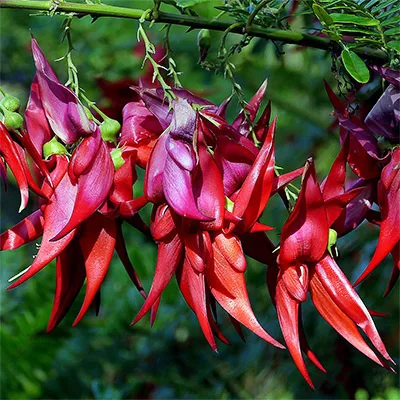
An evergreen shrub with climbing stems up to 4m high, dark green pinnate leaves up to 15cm long and made up of 13 to 25 leaflets. Hanging clusters of up to 15 deep pink, claw-like flowers, each 7cm long, appear in late spring and early summer
Scientific classification
- Species
- lobster claw 'Roseus' (Clianthus puniceus 'Roseus')
- Genus
- Clianthus
- Family
- Fabaceae
- Order
- Fabales
- Class
- Magnoliopsida
- Phylum
- Tracheophyta
- Information to be completed
- Toxicity
- Shrubs · Climber Wall Shrub
- Plant type
- 2.5-4 metres
- Height
- 2.5-4 metres
- Spread
- Evergreen
- Foliage
- Climbing
- Habit
- Spring · Summer · Autumn · Winter
- Season of interest
- Full sun
- Sunlight
- Information to be completed
- Ideal temperature









lobster claw 'Roseus' pictures
Distribution of lobster claw 'Roseus'
Distribution map
- Native
- Introduced
- Cultivated
Source:WCVP v16 · Royal Botanic Gardens, Kew · CC BY 3.0 · Boundaries:WGSRPD / TDWG
lobster claw 'Roseus' care guide
- Deep watering after substrate half dry, well drained loamy growing soil
- Watering
- Full sun
- Sunlight

Watering
Deep watering after substrate half dry, well drained loamy growing soil
Fertilizing
 Fertilizing
Diluted flowering shrub feed every four weeks spring summer months
Pruning
 Pruning
On established wall-trained shrubs, shorten sideshoots to two to four buds from the framework; remove shoots growing towards the wall. Prune annually after flowering on last-year growth, or in late winter or early spring on current-year growth.
Propagation
 Propagation
Propagate by semi-ripe cuttings in summer
Growing
 Growing
Grow in well-drained soil in full sun on trellis, wires or other supports, and in a sheltered position such as a south-facing or west-facing wall, or under glass; use a thick dry mulch to protect the roots over winter
Common pests and diseases
Diseases
Generally disease free
Pests
May be affected by glasshouse red spider mite and mealybugs
Explore the plant health library →




