
snowberry
Also known as: Information to be completed
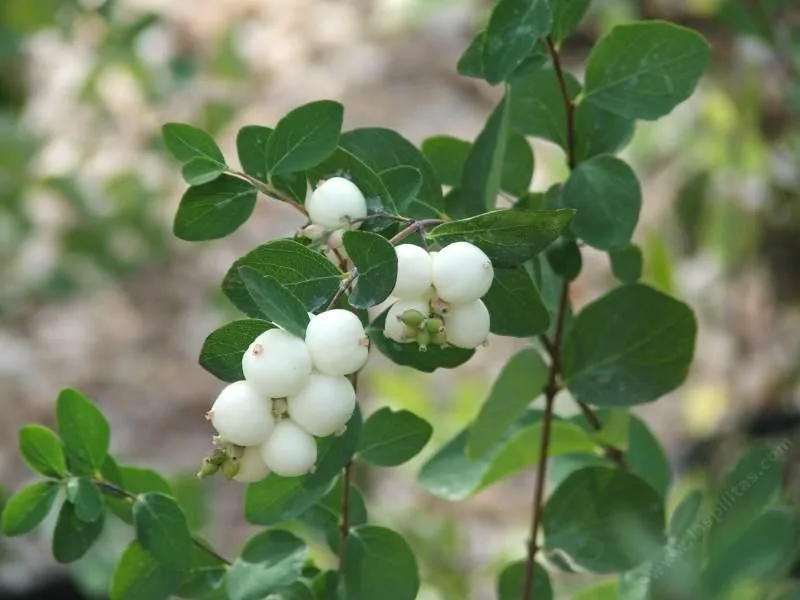
A vigorous, thicket-forming deciduous shrub, up to 3m high, with broadly oval-shaped dark blue-green leaves held in pairs along the stems; occasionally some are lobed. Short clusters of small pink bell-shaped flowers are produced in early summer; these are followed by tight clusters of large white berries that persist into winter. Spreads by suckering
Scientific classification
- Species
- snowberry (Symphoricarpos albus var. laevigatus)
- Genus
- Symphoricarpos
- Family
- Caprifoliaceae
- Order
- Dipsacales
- Class
- Magnoliopsida
- Phylum
- Magnoliophyta
- Harmful if eaten. Wear gloves and other protective equipment when handling
- Toxicity
- Shrubs
- Plant type
- 2.5-4 metres
- Height
- 2.5-4 metres
- Spread
- Deciduous
- Foliage
- Bushy · Columnar upright
- Habit
- Autumn · Spring · Summer · Winter
- Season of interest
- Full shade · Full sun · Partial shade
- Sunlight
- Information to be completed
- Ideal temperature









snowberry pictures
Distribution of snowberry
Distribution map
- Native
- Introduced
- Cultivated
Source:WCVP v16 · Royal Botanic Gardens, Kew · CC BY 3.0 · Boundaries:WGSRPD / TDWG
Toxicity
Harmful if eaten. Wear gloves and other protective equipment when handling
snowberry care guide
- Moderate regular watering, avoid prolonged drought or waterlogging
- Watering
- Full shade · Full sun · Partial shade
- Sunlight

Watering
Moderate regular watering, avoid prolonged drought or waterlogging
Fertilizing
 Fertilizing
Balanced feed in spring and light repeat in growth season
Pruning
 Pruning
Little pruning is needed. Remove diseased, damaged, crowded or crossing shoots and unwanted growth. Timing depends on the plant: generally late winter or early spring; plants prone to bleeding and deciduous magnolias need different timing, and deciduous azaleas and lilacs are pruned after flowering.
Propagation
 Propagation
Propagate by softwood cuttings in summer or hardwood cuttings in autumn, or by division, transplanting rooted offsets in autumn
Growing
 Growing
Tolerates most soils and conditions, tolerant of pollution. Spreads vigorously; has potential to become a nuisance if suckering is not managed
Common pests and diseases
Diseases
May be susceptible to fungal leaf spots, powdery mildews, rust diseases, stem galls and honey fungus (rarely)
Pests
May be susceptible to aphids
Explore the plant health library →




