
heather 'Dorothy Metheny'
Also known as: Information to be completed
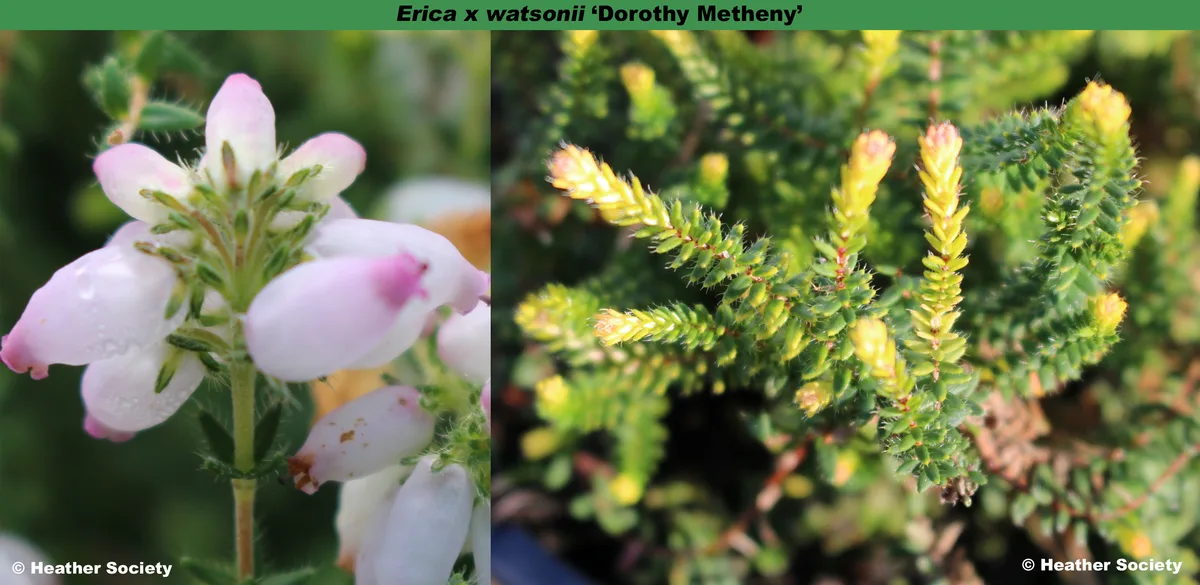
Compact, spreading evergreen shrub to about 30cm high and 45cm wide, with tiny, needle-like, bright green leaves, the young shoots tipped yellow in spring. Dense racemes of urn-shaped flowers, with constricted mouths, pale lilac, darkening with age, appear from midsummer to autumn
Scientific classification
- Species
- heather 'Dorothy Metheny' (Erica × watsonii 'Dorothy Metheny')
- Genus
- Erica
- Family
- Ericaceae
- Order
- Ericales
- Class
- Magnoliopsida
- Phylum
- Magnoliophyta
- Information to be completed
- Toxicity
- Shrubs
- Plant type
- 0.1-0.5 metres
- Height
- 0.1-0.5 metres
- Spread
- Evergreen
- Foliage
- Bushy
- Habit
- Spring · Summer · Autumn · Winter
- Season of interest
- Full sun
- Sunlight
- Information to be completed
- Ideal temperature









heather 'Dorothy Metheny' pictures
Distribution of heather 'Dorothy Metheny'
Distribution map
- Native
- Introduced
- Cultivated
Source:WCVP v16 · Royal Botanic Gardens, Kew · CC BY 3.0 · Boundaries:WGSRPD / TDWG
heather 'Dorothy Metheny' care guide
- Keep acidic soil evenly moist with sharp drainage
- Watering
- Full sun
- Sunlight

Watering
Keep acidic soil evenly moist with sharp drainage
Fertilizing
 Fertilizing
Light ericaceous feed in spring and early summer
Pruning
 Pruning
Shorten flowered shoots to about 1.5–2.5 cm from the previous year's growth. Prune after flowering has finished.
Propagation
 Propagation
Propagate by semi-ripe cuttings in mid or late summer
Growing
 Growing
Best grown in neutal to acid well-drained soil in an open site with full sun. Ideal for growing in containers in lime free (ericaceous) potting compost. See Hardy heathers and erica cultivation
Common pests and diseases
Diseases
May be susceptible to fungal diseases, including honey fungus (rarely), and Phytophthora root rot, in wet conditions
Pests
Generally pest-free
Explore the plant health library →




